Comments on Nov 10 & Nov 20 Scarcity Pricing discussions

Price formation enhancements

Print
Comment period
Nov 25, 09:30 am - Dec 12, 05:00 pm
Submitting organizations
View by:

Bay Area Municipal Transmission Group (BAMx)
Submitted 12/12/2025, 02:00 pm

Submitted on behalf of
City of Palo Alto Utilities and City of Santa Clara (Silicon Valley Power)

Contact

Lena Perkins (lena.perkins@paloalto.gov)

1. Please summarize your organization’s overall stance on comprehensive scarcity pricing proposals.

The Bay Area Municipal Transmission Group (BAMx[1]) thanks the ISO for accepting our comments on this initiative. We believe the timing is premature for additional changes to scarcity pricing in the ISO market beyond those agreed upon this summer and we respectfully request that the ISO prioritize the Demand and Distributed Energy Market Integration (DDEMI) initiative over additional scarcity pricing discussions. The DDEMI initiative is the appropriate venue to consider incentives and structures to improve participation of behind-the-meter (BTM), demand-side resources in energy markets. BAMx has fundamental affordability and equity concerns over implementing additional scarcity pricing mechanisms that will raise electricity costs for all customers[2], regardless of their elasticity of demand or ability to pay. We believe that the principles of least-cost resource planning dictate that the ISO prioritize the development of participation pathways for conservation resources, demand response resources, and existing behind-the-meter storage resources over additional scarcity pricing proposals.

We ask the CAISO to explain why the scarcity pricing rationale, proposals, and stakeholder effort leading up to the August 22, 2025, straw proposal[3] have been discarded in favor of the scarcity pricing initiative restarted in November. In that straw proposal, the ISO identified key hurdles that must be addressed before a comprehensive scarcity pricing product could be evaluated. Those hurdles included EDAM implementation, flexible ramping product (FRP) performance after EDAM implementation, and ancillary service (AS) procurement for the WEIM/EDAM footprint. CAISO further describes a staged approach where future scarcity pricing evolves in coordination with related market designs. Finally, the ISO stated that it was “prudent to pause consideration on an extended FRP mechanism while it evaluates ongoing performance of the existing FRP product” and “the ISO does not currently plan to pursue a VOLL-based system.” We agree with this rationale as originally stated by the ISO in August, and question why the ISO has done an abrupt about-face and is seemingly discarding the consensus that was described in the August straw proposal.

BAMx supports the three proposals from the August straw proposal: to make RTPD and RTD prices more consistent during scarcity, to trigger scarcity pricing when operators shed load, and to enhance scarcity pricing when operators arm load and believes these changes should be implemented and tested before any additional scarcity pricing enhancements are considered.

The ISO appears to assume that current market structures are insufficient to encourage demand bidding and investment in supply resources and proposes Hogan’s operating reserve demand curve (ORDC) scarcity pricing mechanism[4] to incentivize demand bidding and resource investment. BAMx is skeptical that either assumption holds in the current CAISO market. As seen from voluntary demand reductions during flex alerts, there are a substantial number of customers who are willing to curtail non-essential loads simply when asked and without any compensation. It is reasonable to expect that there is an even greater amount of flexible load in the CAISO that would participate in compensated DR programs if improved awareness, participation pathways, and incentives existed. Robust DR programs would also have the benefit of reducing emissions during scarce periods without causing an increase in rates, while an ORDC concept without additional demand participation is likely to increase emissions by increasing payments to operating reserves which during periods of scarcity are likely to be most-expensive and least-efficient generation resources. The volume of supply-side and storage resources that are currently seeking to interconnect to the ISO system also suggests that current market prices and structures are sufficient to incentivize the development of supply-side resources.

BAMx does not support spending additional ISO or stakeholder effort on the scarcity pricing portion of the Price Formation Enhancements initiative until:

  1. the improvements discussed in August and broadly accepted by stakeholders are implemented and evaluated,
  2. the DDEMI and Storage Modeling and Design working groups have improved participation of behind-the-meter and storage resources in electricity markets, and

the ISO publishes detailed analysis of the impacts and benefits of any proposed scarcity pricing mechanism, in the context of the system impacts it is intended to mitigate.


[1] BAMx consists of City of Palo Alto Utilities and City of Santa Clara, Silicon Valley Power

[2] Electricity Scarcity Pricing Through Operating Reserves, William W. Hogan, Economics of Energy & Environmental Policy, Vol 2 No 2, 2013. https://www.pserc.cornell.edu/empire/2_2_a04.pdf http://dx.doi.org/10.5547/2160-5890.2.2.4

[3] https://stakeholdercenter.caiso.com/InitiativeDocuments/StrawProposal-Price-Formation-Enhancements-BAA-Level-MPM-Scarcity-Pricing.pdf

[4] Ibid

2. Does your organization support the concept of an “Energy Supply Margin” mechanism as a viable alternative to creating a new reserve product? If the ISO adopts this approach, how should “available supply” be defined (e.g., time horizon, transmission constraints)?
The working group discussed a concept for an "Energy Supply Margin" mechanism, where a scarcity price is calculated based on the margin of available supply relative to demand.

We feel it is premature to be asking stakeholders to spend scarce time and effort on additional scarcity pricing changes when we have not implemented the changes that were tentatively agreed upon in the August timeframe. Additional changes to the market’s scarcity pricing mechanisms should wait until other CAISO initiatives are given time to integrate additional flexible load and behind-the-meter resources into the market.

3. At what level should scarcity be measured and priced (footprint, BAA, nodal)? Please explain your reasoning and any implementation considerations.
The working group discussed applying scarcity pricing at the footprint level, the BAA level, or potentially the nodal level.

BAMx believes it is premature to discuss the level at which to apply a scarcity pricing design when critical analysis has not yet been conducted and there is a previous scarcity pricing proposal that has not been implemented.

4. Please provide any other feedback on the November 10 and 20 working group discussions not covered above.

We would like clarification from the ISO on when or if the scarcity pricing modifications discussed in August (to make RTPD and RTD prices more consistent during scarcity, to trigger scarcity pricing when operators shed load, and to enhance scarcity pricing when operators arm load) are still going to be implemented.

5. Are there any specific topics or questions you would recommend the working group address next?

Prior to resuming stakeholder engagement on scarcity pricing issues, CAISO should undertake further investigation so that stakeholders and the ISO can fully understand the potential impacts of any scarcity pricing design. BAMx requests that the CAISO publish detailed analysis to illustrate the possible interactions with other market initiatives and the implications of such a scarcity pricing mechanism. This analysis should include the following topics.

  • The 2020 and 2022 extreme weather events and associated electricity market scarcity are frequently raised as a justification for changes to existing CAISO scarcity pricing design. How would the proposed designs have influenced system operations and market scarcity during those events? Please publish an analysis of how any proposed scarcity pricing mechanism would have influenced actual system conditions during the 2020 and 2022 CAISO scarcity events.
  • The Hogan scarcity pricing article included estimates of the pricing impact of the ORDC scarcity pricing mechanism to ERCOT in 2011 and 2012. It found price increases in both years with impacts varying according to conditions. What will be the pricing impacts to the CAISO if an ORDC or energy supply margin mechanism are adopted? Please produce and publish estimates of the impact to ISO market prices from the proposed scarcity pricing mechanism, both during scarce periods and over the year. 
  • Hogan assumes that existing market structures are insufficient to encourage demand bidding and investment in supply resources and proposes the ORDC scarcity pricing mechanism to incentivize demand participation and resource investment by increasing market prices as reserves become scarcer. BAMx is skeptical that either assumption holds in the current CAISO market. In fact, based on voluntary demand reductions during flex alerts, there appear to be a substantial number of end users who are willing to curtail non-essential loads simply when asked and without any compensation. That indicates that there is a great deal of flexible load in the CAISO that would participate in a voluntary, incentivized demand response program if improved awareness, participation pathways, and incentives existed. Robust DR programs would also have the benefit of reducing emissions during scarce periods without causing an increase in rates, while an ORDC concept without first ensuring additional demand participation is likely to increase emissions by increasing payments to operating reserves. During periods of scarcity these are likely to be most-expensive and least-efficient generation resources. Will proposed scarcity pricing designs incentivize additional demand bidding? Please produce and publish estimates of the additional demand-side resources the ISO expects will be incentivized through the proposed scarcity pricing mechanism and change in emissions that result.
  • The volume of supply-side or storage resources that are seeking to interconnect to the ISO system also suggests that current market prices and structures are sufficient to incentivize the development of more supply-side resources than the ISO can interconnect in a short time. Please produce and publish estimates of the additional supply-side resources the ISO expect will be incentivized through the proposed scarcity pricing mechanism and change in emissions that result.
  • Hogan indicates that the operating reserve demand curve scarcity pricing concept may be incompatible with capacity planning requirements such as the planning reserve margin (PRM) or resource adequacy (RA) requirements. Please publish an analysis of how the ORDC or energy supply margin proposals are compatible and consistent with capacity planning requirements such as the default PRM, and how mechanisms considered in the Price Formation Enhancements initiative are compatible with and expected to interact with the various proposals in the Resource Adequacy initiative.

How will the ISO limit or mitigate the incentive to withhold supply to “chase” higher prices?

Bonneville Power Administration
Submitted 12/12/2025, 02:08 pm

Contact

Bonneville Power Administration (BPAMarketInitiatives@bpa.gov)

1. Please summarize your organization’s overall stance on comprehensive scarcity pricing proposals.

Bonneville strongly supports development of a comprehensive scarcity pricing proposal in the Western Energy Imbalance Market.  In principle, Bonneville is supportive of initiatives that promote transparent and accurate pricing in the market and reduce the need for out-of-market actions to maintain reliability.  Scarcity pricing is an acknowledged critical component of organized electricity markets to produce fair and accurate prices that reflect the true operational conditions on the electric system in the near term, and promote appropriate investment in resources in the long term.

2. Does your organization support the concept of an “Energy Supply Margin” mechanism as a viable alternative to creating a new reserve product? If the ISO adopts this approach, how should “available supply” be defined (e.g., time horizon, transmission constraints)?
The working group discussed a concept for an "Energy Supply Margin" mechanism, where a scarcity price is calculated based on the margin of available supply relative to demand.

Bonneville supports the Energy Supply Margin as a viable approach to incorporating scarcity pricing in the market. As highlighted in the working groups, the ESM and potentially more complex new reserve product can be functionally equivalent. Bonneville acknowledges that the parameterization of the ESM approach will require substantive discussion going forward, but believes that it is worth pursuing in earnest.

At this time, Bonneville has no strong opinions on the time horizon or transmission constraint parameterization of the ESM and looks forward to additional discussion.

3. At what level should scarcity be measured and priced (footprint, BAA, nodal)? Please explain your reasoning and any implementation considerations.
The working group discussed applying scarcity pricing at the footprint level, the BAA level, or potentially the nodal level.

Bonneville appreciates the intuitive appeal of aligning the ESM approach with other reliability-related concepts that are defined at the balancing authority area (BAA) level. Further, at first blush, measurement and pricing of scarcity at the BAA level appears to strike the right balance between sufficient specificity to identify entities that are nearing scarcity while avoiding the potential for false precision of scarcity measured at the nodal level. 

With the limited discussion on geographic granularity centering around a BAA definition, Bonneville would appreciate extended discussion on the geographic granularity of the ESM approach, particularly related to alternatives for scaling the energy supply margin for BAAs having vastly different magnitudes of load.

4. Please provide any other feedback on the November 10 and 20 working group discussions not covered above.

Bonneville acknowledges the significance of the ongoing changes in Western markets and the impacts these initiatives have on participating organizations; however, initiatives that enhance transparent and accurate pricing are critical in ensuring markets can adequately manage evolving grid challenges.  Bonneville encourages CAISO and the stakeholder community to maintain momentum toward proactively incorporating more equitable, efficient market features. 

5. Are there any specific topics or questions you would recommend the working group address next?

California Community Choice Association
Submitted 12/12/2025, 02:15 pm

Contact

Shawn-Dai Linderman (shawndai@cal-cca.org)

1. Please summarize your organization’s overall stance on comprehensive scarcity pricing proposals.

The California Community Choice Association (CalCCA) does not support the California Independent System Operator’s (CAISO) pivot away from its August 22, 2025, Straw Proposal on scarcity pricing.[1] The CAISO’s Straw Proposal put forth proposals for Balancing Authority Area level Market Power Mitigation and targeted enhancements to the CAISO’s existing scarcity pricing mechanisms. CalCCA, among other stakeholders, generally supported the CAISO’s Straw Proposal, including the CAISO’s decision to delay a comprehensive scarcity pricing redesign.[2] After what the CAISO describes as “mixed reviews” from stakeholders on the CAISO’s Straw Proposal,[3] the CAISO is reopening working group discussions on comprehensive scarcity pricing redesign. This is not a good use of CAISO or stakeholder resources for two reasons.

First, the CAISO is in the process of implementing significant market changes, including those resulting from the Extended Day-Ahead Market (EDAM) and the Day-Ahead Market Enhancements (DAME) policies. The impacts of these changes must first be understood before stakeholders can opine on if and how a comprehensive scarcity pricing redesign should be structured. In addition, and as recognized in the Straw Proposal,[4] issues related to the flexible ramping product and ancillary service procurement should be resolved before discussing comprehensive changes to the CAISO’s scarcity pricing mechanisms.

Second, continuing discussions on comprehensive scarcity pricing redesign amounts to searching for a solution without a problem. The CAISO and stakeholders in favor of a comprehensive scarcity pricing redesign have not demonstrated sufficient reliability or market efficiency issues that would benefit from a comprehensive redesign. While accurate price signals are important for attracting supply and ensuring generator performance, the CAISO’s existing scarcity pricing mechanisms and the targeted changes proposed in the Straw Proposal adequately provide those signals without unnecessarily increasing costs on California ratepayers. Further, it has not been demonstrated that increasing prices beyond the CAISO’s existing scarcity prices will result in more price responsive demand. Improving price responsiveness of demand is better addressed through improvements to the CAISO’s integration of demand and distributed energy resources in its market. These improvements are already being discussed in the CAISO’s Demand and Distributed Energy Market Integration initiative.

For these reasons, the CAISO should move forward with the CAISO’s Straw Proposal and postpone discussion of comprehensive scarcity pricing changes until EDAM and DAME implementation is further along and any impacts are known. When and if these discussions continue, the first step should be determining whether there is a justifiable need for continuing conversations regarding comprehensive scarcity pricing redesign.  


[1]            CAISO, Price Formation Enhancements, BAA-Level MPM and Scarcity Pricing Straw Proposal (Aug. 22, 2025) (Straw Proposal): https://stakeholdercenter.caiso.com/InitiativeDocuments/StrawProposal-Price-Formation-Enhancements-BAA-Level-MPM-Scarcity-Pricing.pdf.

[2]            See Straw Proposal, at 46.

[3]            CAISO, Price Formation Enhancements, Scarcity Pricing Working Group Meeting (Nov. 20, 2025) at 6: https://stakeholdercenter.caiso.com/InitiativeDocuments/Presentation-Price-Formation-Enhancements-Nov-20-2025.pdf

[4]             See Straw Proposal, at 46.

2. Does your organization support the concept of an “Energy Supply Margin” mechanism as a viable alternative to creating a new reserve product? If the ISO adopts this approach, how should “available supply” be defined (e.g., time horizon, transmission constraints)?
The working group discussed a concept for an "Energy Supply Margin" mechanism, where a scarcity price is calculated based on the margin of available supply relative to demand.

For the reasons described in Section 1 above, CalCCA does not support further development of an Energy Supply Margin mechanism at this time.

3. At what level should scarcity be measured and priced (footprint, BAA, nodal)? Please explain your reasoning and any implementation considerations.
The working group discussed applying scarcity pricing at the footprint level, the BAA level, or potentially the nodal level.

CalCCA has no comments at this time.   

4. Please provide any other feedback on the November 10 and 20 working group discussions not covered above.

CalCCA has no additional comments at this time.   

5. Are there any specific topics or questions you would recommend the working group address next?

For the reasons described above, the CAISO should move forward with its August 22, 2025, Straw Proposal on Balancing Authority Area level Market Power Mitigation and targeted enhancements to scarcity pricing the CAISO’s existing scarcity pricing mechanisms.[1]


[1]            CAISO, Price Formation Enhancements, BAA-Level MPM and Scarcity Pricing Straw Proposal (Aug. 22, 2025) (Straw Proposal): https://stakeholdercenter.caiso.com/InitiativeDocuments/StrawProposal-Price-Formation-Enhancements-BAA-Level-MPM-Scarcity-Pricing.pdf.

California Energy Storage Alliance (CESA)
Submitted 12/12/2025, 02:44 pm

Contact

Donald Tretheway (donald.tretheway@gdsassociates.com)

1. Please summarize your organization’s overall stance on comprehensive scarcity pricing proposals.

The California Energy Storage Alliance (CESA) appreciates the opportunity to comment on the November 2025 working group discussions on Scarcity Pricing. Since MRTU go-live in 2009, the CAISO market has not had a robust scarcity pricing design. A robust scarcity pricing design would see energy prices gradually increase above the marginal cost resource as the amount of unloaded supply reduces and then remains at administrative pricing levels when in actual scarcity. 

The CAISO should focus on developing a real-time market design proposal that behaves like an operating reserve demand curve (ORDC) used in other ISO/RTOs. The ORDC is an energy market design element ensuring energy prices reflect scarcity conditions in the absence of full ancillary service (AS) co-optimization. This is because not all ancillary services requirements can be relaxed while meeting reliability requirements. Thus, AS re-optimization is not a pre-requisite of implementing an ORDC resulting in a robust scarcity pricing design.

The introduction of imbalance reserves into the day-ahead market introduces a demand curve which can impact energy prices. However, based upon market simulation results shared in the DAME Configurable Parameters Implementation working group meetings, it is premature to determine if robust scarcity pricing is being achieved. Given the data for the limited days studied, it appears that the imbalance reserve requirement is not being met because the imbalance reserve bids are too high – i.e. above the higher steps of the demand curve. This would not result in an opportunity cost adder flowing into the energy price because the imbalance requirement was not met. Rather, the demand curve has correctly determined that the cost of procuring imbalance reserves is greater than the value that imbalance reserves provide in avoiding potential higher costs in real-time if the full uncertainty materialized. Changes to the day-ahead market should be considered after experience with DAME and real-time scarcity pricing being implemented.

The design of imbalance reserves demonstrates the importance of real-time scarcity pricing. Imbalance reserves are not procured to cover 100% of uncertainty – it would be too expensive. Likewise, the must-offer obligations of resource adequacy programs cover a set loss of load expectation and planning reserve margin, not 100% of potential scenarios. Again, it would be too expensive. Real-time scarcity pricing provides a backstop in the event extreme events occur beyond what is planned for day-ahead.

The imbalance reserve up requirement is set to cover a maximum of 97.5% uncertainty and as discussed above will not be procured if the day-ahead cost exceeds the expected real-time benefit. But what if uncertainty materializes above 97.5%, or if, in hindsight, the imbalance reserve demand curve was too low? This is the purpose of a robust scarcity pricing design in the real-time market. As the real-time scarcity pricing design begins to gradually increase prices above the marginal resource, it signals to all supply and demand response resources that the market needs them. This includes supply across the WEIM/EDAM footprint and beyond – including those that do not have an energy award, imbalance reserve award, or reliability capacity award – that they should voluntarily offer into the CAISO operated market.

2. Does your organization support the concept of an “Energy Supply Margin” mechanism as a viable alternative to creating a new reserve product? If the ISO adopts this approach, how should “available supply” be defined (e.g., time horizon, transmission constraints)?
The working group discussed a concept for an "Energy Supply Margin" mechanism, where a scarcity price is calculated based on the margin of available supply relative to demand.

CESA supports the concept of “Energy Supply Margin”. CESA previously used the term “latent reserves” which was defined as “unloaded supply and demand response resources that have voluntarily submitted offers into the market.” Latent reserves are equivalent to an energy supply margin. In order to have robust scarcity pricing, the market optimization needs a requirement that can be relaxed using a demand curve. The relaxation of the requirement establishes the adder to the marginal energy cost which allows prices to rise above the marginal resource. As the relaxation of the requirement increases, the adder to the marginal energy cost increases which provides incentives for new supply to enter the market and for voluntary load reductions by load serving entities. 

The purpose of robust scarcity pricing is to signal the need for additional supply and demand resources to voluntarily offer into the real-time market. Since the real-time market bid submission deadline is 75 minutes prior to the start of the operating hour, the minimum time horizon should be 135 minutes. It may also be appropriate to align with the short-term unit commitment time horizon. Any resource that is on-line or can be committed within the time horizon should be considered available supply in the calculation of the energy supply margin.

If supply is located behind a transmission constraint and is undeliverable to load, it is by definition not available in scarcity conditions. The CAISO should explore simple estimates of unavailable supply that can implemented absent using a deployment scenario. Deployment scenarios are key for imbalance reserves and the flexible ramping products to prevent the market optimization from seeking out resources to award that have no energy opportunity cost. For a robust scarcity pricing design, the goal is to have the best estimate of available supply. One approach could be an estimate of unavailable supply based upon the prior market solution.

As discussed in the previous question, robust real-time scarcity pricing needs to send a price signal when system conditions exceed those that were planned for in the day-ahead market. The real-time demand curve requirement should include load, upward flexible ramping product, upward ancillary services, and high priority exports (PT) from the area. The real-time available supply should include energy awards, flexible ramping up awards, upwards ancillary services awards, low priority exports from the area (LPT), and incremental energy bids less the unavailability adjustment. 

3. At what level should scarcity be measured and priced (footprint, BAA, nodal)? Please explain your reasoning and any implementation considerations.
The working group discussed applying scarcity pricing at the footprint level, the BAA level, or potentially the nodal level.

CESA does not believe nodal scarcity pricing is necessary. As discussed above, an estimate of the deliverability of available supply is sufficient for the purposes of scarcity pricing.

Ideally, scarcity pricing should be applied at the market footprint level; however, given that the WEIM paradigm is largely based on balancing authority areas, the scarcity pricing measurement and pricing may need to be at the balancing authority area level. An argument can be made that balancing authority areas participating in EDAM could be aggregated into a single level because those balancing authority areas share imbalance reserves and reliability capacity. However, if a balancing authority area fails the EDAM resource sufficiency evaluation, it becomes isolated. Also, since the EDAM introduces individual power balance constraints resulting in unique marginal energy costs by balancing authority area, the level of where scarcity should be measured and priced may have been predetermined. But at a minimum, EDAM balancing authority areas that have passed the EDAM resource sufficiency should be able to count potential transfers within the group as available supply to its balancing authority area subject to transfer capability. 

4. Please provide any other feedback on the November 10 and 20 working group discussions not covered above.

CAISO should review the WEIM Assistance Energy transfer design. In the Board memo originally approving the design, CAISO committed “to explore a more robust assistance energy solution that is priced through the market in a subsequent stakeholder process.”[1] The CAISO implemented a sunset date of December 31, 2025, which has been subsequently eliminated in a WEM Governing Body decision this year. A robust real-time scarcity pricing design may allow the CAISO to meet its prior commitment to an in-market energy pricing solution for WEIM Assistance Energy.   


[1] See page 8 at https://www.caiso.com/documents/decisiononresourcesufficiencyevaluationenhancementsphase2-memo-dec2022.pdf

5. Are there any specific topics or questions you would recommend the working group address next?

CESA recommends that CAISO develop a proposed market formulation to implement a demand curve based upon the energy supply margin. An initial market formulation will better inform stakeholders of the key areas of the design that need to be discussed in subsequent price formation working groups.

California ISO - Department of Market Monitoring
Submitted 12/12/2025, 03:10 pm

Contact

Aprille Girardot (agirardot@caiso.com)

1. Please summarize your organization’s overall stance on comprehensive scarcity pricing proposals.

Comments on Price Formation Enhancements

Scarcity Pricing Working Group Sessions – November 10 and 20, 2025

Department of Market Monitoring

December 12, 2025

Summary

The Department of Market Monitoring (DMM) appreciates the opportunity to comment on the ISO’s Price Formation Enhancements Working Group Sessions held on November 10 and November 20, 2025.[1] In the November 2025 working group meetings, stakeholders primarily discussed three issues:

  1. combining scarcity pricing with balancing authority area (BAA) market power mitigation (MPM) enhancements into one final price formation enhancements proposal,
  2. the purpose and scope of comprehensive scarcity pricing enhancements, such as a new reserve product or a latent supply construct, and
  3. whether development and implementation of comprehensive scarcity pricing should be a near term or longer term effort.

DMM does not have concerns moving forward with the proposed BAA MPM changes independent of scarcity pricing enhancements. DMM continues to support long-term pricing enhancements such as an uncertainty product that allows prices to rise gradually, or other mechanisms such as participating demand in real-time. However, DMM does not see the need to implement these pricing mechanisms concurrently or prior to BAA MPM in the short-term.

Some stakeholders have argued that administrative scarcity pricing is necessary to ensure reliability and to attract additional supply and investment in additional capacity. DMM notes that these arguments are most applicable to energy-only markets. The CAISO market operates within a robust resource adequacy framework and therefore administrative scarcity pricing plays a small role in attracting capacity or long-term investment to California.

When considering the scope and applicability of scarcity pricing enhancements, DMM notes that scarcity pricing mechanisms may be unnecessary in the day-ahead market, because the day-ahead market already accounts for uncertainty and provides an avenue for demand to reflect economic willingness to be curtailed.

DMM supports an increase of demand-side participation in the real-time market as an improvement to pricing during scarcity events, as discussed by stakeholders in the working group meetings.


Comments

DMM does not have concerns moving forward with the proposed BAA MPM changes independent of scarcity pricing    

The ISO proposed combining BAA MPM enhancements and scarcity pricing into one final proposal, suggesting that BAA MPM enhancements (specifically subjecting the California ISO to BAA-level MPM) cannot be implemented without scarcity pricing.[2] Some stakeholders expressed concern that implementing BAA MPM enhancements without scarcity pricing could lead to inefficiently low prices during tight conditions and reduce the incentive for external supply to sell into the CAISO market. This argument appears to suggest that in the absence of both a scarcity pricing framework and BAA MPM, external supply may only be incentivized to sell into the CAISO market when prices are elevated by the exercise of market power under tight supply conditions.

DMM does not believe it is necessary or appropriate to rely on the exercise of market power to attract additional supply in scarcity conditions. The ISO’s maximum import bid price is designed to ensure that the opportunity cost of selling in bilateral markets outside of CAISO can be appropriately captured in bid prices when supply is tight around the west. Under true scarcity conditions, mitigation of market power applied to resources within the CAISO balancing area should not prevent available supply offered to the CAISO market from clearing at prices up to the maximum import bid price.[3]

If additional capacity is needed in scarcity conditions within the CAISO BAA beyond what is awarded by the market, ISO operators can utilize manual dispatch on the interties, transactions that are typically paid as bid. While there may be reasons such supply is of limited availability during regional high load events, the structure of CAISO’s maximum import bid price should diminish the risk that such supply is not available to the CAISO market due to better economic opportunities elsewhere. Market based outcomes under current market rules, and limited use of manual dispatch where necessary, are likely more efficient than allowing exercise of BAA level market power with the goal of attracting more supply to the CAISO balancing area. This is especially true given the infrequency of scarcity events.

DMM does not suggest using manual actions as a replacement for long-run pricing enhancements. For example, pricing enhancements that allow prices to rise gradually ahead of scarcity events would allow access to supply that may be unavailable if prices only rise at the moment scarcity is realized. However, DMM highlights that there are other tools the ISO may use in the short-term to meet reliability needs in rare scarcity events, even if BAA MPM were to be implemented independent of scarcity pricing. Continuing to allow any exercise of BAA-level market power is likely to only result in higher market clearing prices and is not necessary to ensure reliability during extreme system conditions.

DMM is not opposed to combining BAA MPM enhancements and scarcity pricing into one final proposal but notes that scarcity pricing is not inherently necessary for implementing BAA MPM enhancements in the short-term. DMM acknowledges that scarcity pricing can be highly administrative and can take a wide variety of forms. The details of implementing an efficient scarcity pricing mechanism will take time to develop, and if combined with BAA MPM, could unnecessarily delay the implementation of MPM enhancements in the short-term.

DMM continues to recommend the ISO create an hour-ahead uncertainty product

DMM continues to recommend that the ISO prioritize the development of a new hour-ahead uncertainty product that would allow the real-time market to better reflect real-time conditions and provide earlier price signals prior to a scarcity event.[4] An uncertainty product with a time horizon longer than one interval would allow capacity and energy prices to rise gradually and reflect upcoming scarcity in more distant advisory intervals. This could allow more capacity to be positioned to respond to upcoming scarcity events. Additionally, a longer uncertainty horizon could mitigate the need to consider other scarcity pricing mechanisms, such as administrative pricing for emergency actions.

Scarcity pricing may play a limited role in attracting capacity or long-term investment to California, as the CAISO market has a robust resource adequacy framework  

Some stakeholders argue that scarcity pricing is intended to attract capacity or long-term investment to California. This type of argument is most applicable to energy-only markets that do not have a resource adequacy framework or capacity market. Such arguments do not apply as directly to the CAISO market, which has a robust resource adequacy framework that requires sufficient capacity procurement.

Instead of attracting capacity and long-term investment, scarcity pricing in the CAISO market primarily would function to attract supply during tight market conditions. More specifically, DMM supports the implementation of pricing enhancements such as a new uncertainty product that would allow gradually increasing prices to better dispatch and position resources in anticipation of a scarcity event. This would improve the ability to dispatch additional supply in an upcoming hour in anticipation of an upcoming scarcity event.

Scarcity pricing mechanisms may be unnecessary in the day-ahead market  

The ISO proposed the idea of applying scarcity pricing mechanisms to the day-ahead market.[5] DMM notes that scarcity pricing mechanisms may be unnecessary in the day-ahead market, because uncertainty and demand’s willingness to be curtailed are both already accounted for in the day-ahead market.

Scarcity pricing attempts to quantify the expected value of lost load, considering an estimate of load’s willingness to pay and the probability of curtailment as reserves are depleted. In real-time, this essentially acts as a proxy for demand that is not participating economically. While a significant portion of load self-schedules as a price taker in the day-ahead market, load can participate with economic bids in the day-ahead timeframe. If some portion of demand is fully participating, there may be less need to estimate the value of lost load because demand can signal its willingness to curtail through bids. The amount of economically participating load may be sufficient to resolve potential scarcity conditions in the day-ahead market. The day-ahead market enhancements introduction of imbalance reserve capacity and reliability capacity is likely to further negate the need for scarcity pricing in the day-ahead timeframe.

Because the CAISO day-ahead market already includes some participating demand, imbalance reserves that procure capacity to meet net load uncertainty, and procurement of reliability capacity to meet forecasted demand, DMM believes scarcity pricing is likely unnecessary in the day-ahead timeframe.

DMM supports an increased role of demand-side participation in real-time

In the November 20, 2025 working group meeting, stakeholders argued that providing more optionality and flexibility to demand-side resources could improve scarcity pricing by better incorporating demand’s willingness to curtail load in real-time. DMM agrees that there is a role for increased demand-side participation in real-time. If demand were able to signal its willingness to curtail through real-time bids, the market could more efficiently dispatch limited supply during tight conditions. With increased demand-side participation, the market could potentially avoid dispatching the next marginal supply-side resource in the bid stack or relaxing the power balance constraint and triggering administrative pricing. This could avoid unnecessary price spikes during tight conditions, when price responsive demand is willing and able to economically curtail.

DMM notes that demand-side participation in real-time could be a market-based approach that is less administrative and provides a response to tight conditions other than just extremely high prices. This approach could be uniformly applied to Western Energy Imbalance Market (WEIM) entities, as it is not contingent upon other market design elements such as ancillary services procurement. Where technologically feasible, DMM sees this as a viable option for incremental enhancements to price formation in the CAISO market.

As part of CAISO’s Demand and Distributed Energy Market Integration (DDEMI) Working Group, DMM has discussed its support for increased demand-side participation and has noted that real-time load bidding for resources that are able to respond to real-time economic signals could increase market reliability and efficiency.[6] DMM supports further discussion of demand-side participation as a price formation issue.  


[1]  Price Formation Enhancements – Working Group Sessions 14 and 15, California ISO, November 10, 2025 and November 20, 2025: https://stakeholdercenter.caiso.com/StakeholderInitiatives/Price-formation-enhancements

[2]  Price Formation Enhancements Working Group Session 14, California ISO, November 10, 2025, p 7: https://stakeholdercenter.caiso.com/InitiativeDocuments/Presentation-Price-Formation-Enhancements-Nov-10-2025.pdf

[3]  As described in Attachment P of the Business Practice Manual for Market Instruments, the maximum import bid price is determined by bilateral prices outside of the ISO market and will allow bids up to $2,000/MWh when certain conditions occur in the ISO market. These criteria will likely be satisfied on days when scarcity is possible during west-wide tight supply conditions. DMM recognizes that the ISO’s maximum import bid price design has potential to introduce the impacts of market power in areas outside the CAISO BAA that influence bilateral prices into ISO market clearing prices. However, this is a distinct issue from the question of whether supply would not be offered to the ISO market due to an inability to receive prices potentially elsewhere outside the ISO market.

[4]  2024 Annual Report on Market Issues and Performance, Department of Market Monitoring, August 7, 2025, pp 27-28: https://www.caiso.com/documents/2024-annual-report-on-market-issues-and-performance-aug-07-2025.pdf

[5]  Price Formation Enhancements Working Group Session 14, California ISO, November 20, 2025, p 26: https://stakeholdercenter.caiso.com/InitiativeDocuments/Presentation-Price-Formation-Enhancements-Nov-20-2025.pdf 

[6]  Comments on Demand and Distributed Energy Market Integration Working Group, Department of Market Monitoring, November 6, 2025: https://www.caiso.com/documents/dmm-comments-on-demand-and-distributed-energy-market-integration-working-group-nov-06-2025.pdf

2. Does your organization support the concept of an “Energy Supply Margin” mechanism as a viable alternative to creating a new reserve product? If the ISO adopts this approach, how should “available supply” be defined (e.g., time horizon, transmission constraints)?
The working group discussed a concept for an "Energy Supply Margin" mechanism, where a scarcity price is calculated based on the margin of available supply relative to demand.

Please see the PDF attached below the final question for DMM's fully formatted complete set of comments. For the reader's convenience, the complete text of the comments is pasted in response to #1, but there may be some formatting errors.

3. At what level should scarcity be measured and priced (footprint, BAA, nodal)? Please explain your reasoning and any implementation considerations.
The working group discussed applying scarcity pricing at the footprint level, the BAA level, or potentially the nodal level.

Please see the PDF attached below the final question for DMM's fully formatted complete set of comments. For the reader's convenience, the complete text of the comments is pasted in response to #1, but there may be some formatting errors.

4. Please provide any other feedback on the November 10 and 20 working group discussions not covered above.

Please see the PDF attached below the final question for DMM's fully formatted complete set of comments. For the reader's convenience, the complete text of the comments is pasted in response to #1, but there may be some formatting errors.

5. Are there any specific topics or questions you would recommend the working group address next?

Please see the PDF attached below the final question for DMM's fully formatted complete set of comments. For the reader's convenience, the complete text of the comments is pasted in response to #1, but there may be some formatting errors.

California Public Utilities Commission
Submitted 12/16/2025, 03:22 pm

Contact

Karl Stellrecht (Karl.Stellrecht@cpuc.ca.gov)

1. Please summarize your organization’s overall stance on comprehensive scarcity pricing proposals.

Energy Division staff (ED staff or staff) of the California Public Utilities Commission (CPUC) develops and administers energy policy and programs to serve the public interest, advises the CPUC, and ensures compliance with CPUC decisions and statutory mandates. ED staff provides objective and expert analyses that promote reliable, safe, and environmentally sound energy services at just and reasonable rates for the people of California. 

ED staff appreciates the opportunity to comment on CAISO’s approach to scarcity pricing in this Price Formation Enhancements Working Group.?In general, ED staff supports incremental and minor adjustments to scarcity pricing due to the major energy market changes already coming with the launch of the Extended Day Ahead Market (EDAM) in 2026. ED staff is concerned that introducing a new scarcity pricing mechanism would create duplicative efforts and unnecessary costs for California, which could negatively impact ratepayer affordability goals. A new scarcity pricing mechanism would likely duplicate multi-pronged California efforts to ensure adequate reliability and capacity resources are readily available every hour of the year to the California energy markets to ensure reliability. Entities within the CAISO BAA have already invested billions of dollars to ensure adequate, safe and reliable capacity is available at least cost to the energy markets. Scarcity pricing is unlikely to result in new physical infrastructure investments that will ensure reliability, nor will it result in additional capacity being made available to the energy markets that is not already provided through the numerous existing mechanisms for ensuring adequate capacity is supplied to the energy markets for potential dispatch during every hour of the year. 

The existing processes already designed to ensure reliability that could be impacted by this proposal include: 

  • California’s Resource Adequacy (RA) framework requires Load Serving Entities (LSE) to procure specific amounts of capacity to ensure adequate and reliable supply. The current planning reserve margin enforced by the CPUC on all LSEs subject to CPUC jurisdiction is 18 percent above the CEC’s adopted load forecast; in addition, there are several additional percentage points (above 18 percent) of capacity available to serve reliability under a variety of circumstances – including some non-RA eligible reliability resources. Taken together, the amount of California-mandated reliability requirements and additional reliability resources, that will be made available to the energy markets, exceeds 20 percent of the load forecast for every month of the 2026 Compliance year. 

  • California’s is already making major investments in supply side and demand side Demand Response (DR) resources to ensure reliability. The CPUC has authorized nearly two billion dollars for the IOUs’ 2023-2027 DR portfolios alone.1 And this does not include DR investments by non-investor owned utility (IOU) LSEs, or the DR that these LSEs procure separately through RA contracts. A subset of DR resources count towards RA requirements, but all DR programs and products support reliability under various conditions. 

  • California ratepayer investments in the effective “Planning Reserve Margin” via CPUC-authorized infrastructure investments in excess of RA requirements.  

  • California ratepayer investments in Reliability Must Run (RMR) resources and Capacity Procurement Mechanism (CPM) resources, both procured by the CAISO, are designed to support reliability and ensure that California ratepayers pay for capacity to be available to the energy markets on a daily basis under a variety of conditions.  

  • California’s Integrated Resource Planning (IRP) and Renewable Portfolio Standard (RPS) programs are both designed to ensure new capacity resources are being planned, procured, contracted, and developed to provide energy and capacity products to the California energy markets. These resources provide a range of reliability benefits to the markets and are largely reported to the CAISO in near real-time through the RA program.  Without the forward contracting obligations of the IRP procurement requirements and RPS mandates, these resources would not be developed – which is why scarcity pricing by itself will be unlikely to yield development or retention of resources. 

  • Since the 2020 CAISO energy market scarcity events, the CAISO has integrated 15 GW of storage capacity and the CPUC has approved an additional 15.3 GW of new storage capacity that is expected to come online in the next 4 years.2  

  • California invested significant annual ratepayer costs to retain Diablo Canyon Nuclear Power Plant in SB 846. The plant currently supplies approximately 9 percent of California’s energy production. The CPUC approved $722.6 million to extend plant operations from September 1, 2023, through December 31, 20253, and this year approved $382.2 million4  for 2026 extended operations. 

Importantly, any new scarcity pricing should be designed with and appropriately account for these existing elements which can significantly impact price formation in direct or indirect ways. 

ED staff recommends the CAISO postpone “comprehensive” scarcity pricing modifications in order to first evaluate the impacts and benefits EDAM actually generates for all market participants, including California energy customers. CAISO expects EDAM to produce diversity and reliability benefits, which if achieved, will reduce the minimal usefulness of any additional reliability benefits that CAISO anticipates scarcity pricing might achieve. If EDAM induces capacity to bid into the CAISO markets, then CAISO markets should have additional capacity bidding in – beyond the capacity provided by the RA program, the non-RA eligible DR and ‘effective planning reserve programs’, and any available capacity not-otherwise under RA contract.   

The purpose of scarcity prices is to merely increase the available energy rents for suppliers – which can only go to suppliers that are somehow useful in excess of all forward planning reserve margins. While such extreme events may occur, they should be rare, and there are already mechanisms available for energy markets to far exceed marginal costs on a temporary basis, up to a bid cap of $2,000 per MWh. CAISO should consider analyzing the potential impact of scarcity pricing on costs for California customers and other EDAM BAAs to ensure that any proposed scarcity pricing is not duplicative to existing efforts in participating BAAs. CAISO should provide measurable estimates of how much additional supply – in terms of MWs, source, and reliability – that could be induced by scarcity pricing which would not otherwise already be available because of EDAM, RA, IRP, RPS, non-RA eligible capacity resources, etc. 

Overview 

Rather than create new scarcity pricing products or mechanisms that may induce a very unlikely and small amount of new capacity during extremely rare events – and yet subject the entire energy market stack to a very high price spike – it would be more effective to reform existing CAISO market mechanisms at this time,?such as the Resource Adequacy Availability Incentive Mechanism (RAAIM) or extend the uncertainty time horizon for the Flexible Ramping Product (FRP) as proposed by the Department of Market Monitoring (DMM).?Likewise, SCE has correctly suggested that the existing EDAM design for emergency assistance could already accomplish the goal of curing supply deficiencies (i.e. attaining additional capacity to bid into the market) during temporary, rare, and difficult-to-plan-for extreme events.  

Energy market solutions cannot resolve all the challenges concerning resource constraints and reliability. Energy markets are very effective at optimally dispatching available capacity resources; forward capacity procurement requirements (such as the RA program or RMR/ CPM) are much better suited to ensuring that capacity is developed (and/or retained) and then required to bid into energy markets for optimal dispatch. Scarcity pricing cannot build new resources instantly; it can only provide a high payment to resources during an emergency with no connection to or guarantee that such revenues will be invested in building new capacity to avoid such price spikes from reoccurring. The CAISO market is not the mechanism in which LSEs procure long-term supply and capacity products to provide reliability.?The market is only responsible for managing the dispatch of existing resources. High prices during a scarcity event do not lead to additional construction of new resources.  Instead, high prices only serve to extract rents from customers that cannot react in real time to avoid paying. This is because the system is already pre-loaded with the capacity amount established via the planning reserve margin (PRM) set by local regulatory authorities' RA programs. 

The legislature has given the IOUs and the CPUC a host of requirements to meet for procurement planning, all of which are completed outside of the CAISO market.?For instance, Pub. Util. Code §454.5(b)(9)(C) requires each utility to “first meet its unmet resource needs through all available energy efficiency and demand reduction resources that are cost effective, reliable, and feasible.”?Other long-term procurement and transmission solutions to increase supply would be more effective than creating new scarcity pricing mechanisms that increase prices for California ratepayers.?In considering scarcity pricing, ED staff emphasizes that market rules that allow for significant high price periods to be sustained would run counter to the best interests of customers.?It has proven difficult, if not impossible, to put breaks on a price spike event in real time; and high prices for even a few days can lead to significant energy costs that will be passed onto customers.  

For example, the December 2022 gas price spike events led to $3 billion in additional electricity market costs paid to electricity suppliers in a single month that had to be recovered from electricity customers. (additional costs were borne by gas customers). The additional energy costs did not directly lead to any new gas or electricity infrastructure to avoid future price spikes. (The CPUC has an ongoing investigation (I-23-03-008) into these gas price spikes and the impact on customers.)  ED staff therefore encourages consideration of Pub. Util. Code § 345.5(b)(2), which directs CAISO to manage the energy markets in a manner consistent with, “[r]educing, to the extent possible, overall economic cost to the state’s consumers.” In this way, the CPUC, the CAISO Board of Governors, and the WEM Governing Body have a shared interest in implementing solutions that reduce costs for ratepayers wherever possible. ? 

Scarcity Pricing  

Before moving forward with any new scarcity pricing mechanism, CAISO should fundamentally address:  

  1. whether scarcity pricing is needed and if so, why;  

  1. the treatment of California exports during scarcity conditions;  

  1. and how adjoining BAAs govern their own reserves during periods of both coincident and non-coincident scarcity conditions.  

CAISO does not necessarily need to adopt a proposal to ensure market prices reflect scarcity pricing during load-shedding events, unless "scarcity”, i.e. high prices, have a potential to induce additional supply to mitigate a load-shedding situation. For example, if there is a physical outage constraint on the grid, no amount of supply at any price will induce supply. Therefore, load should not automatically seek to pay additional rent to generation above non-scarcity prices if it will not change grid operations. Scarcity pricing should only be used sparingly, only for a limited period, and only if it has a potential to induce / increase supply. 

Before consideration of any new scarcity pricing, CAISO should ensure that the CAISO BAA does not experience scarcity conditions due to a prioritization of exports. ED Staff is concerned that WEIM transfers and scarcity pricing mechanisms in CAISO could distort prices and potentially lead to the activation of CAISO BAA reserves – which had been procured for the support of CAISO BAA reliability – in order to support energy transfers to other BAAs. If the dip into those reserves also triggers scarcity prices, then CAISO BAA load would pay high rents merely to support exports. Therefore, ED Staff requests that CAISO clearly explain to stakeholders the order of operations for emergency conditions and activation of load shedding (possibly pointing to the CAISO BAA BPM for system emergencies and noting how it is different from RC West operating procedures, if at all) and requests clarification on the following questions: 

  • Would CAISO cut low priority exports post-HASP before arming load and triggering scarcity pricing?   

  • Does CAISO hold reserves for low priority exports, and what NERC requirements apply to any such requirements?  

  • How will CAISO ensure that reserves are activated for the intended procurement purpose, and not to support energy exports in scarcity conditions? 

There are numerous additional open questions on how scarcity pricing and any proposed measures for the CAISO BAA would interact with and/or account for conditions in and actions taken by other BAAs. ED staff would appreciate answers to the following questions, which were submitted to CAISO by Calpine5 almost two years ago on February 19, 2024, and in our own comments this fall, but remain important and have still not been addressed: 

  • How do adjoining BAAs deploy reserves that they hold outside the market? 

  • Do they hold reserves beyond that required by NERC? 

  • Are Reserve Sharing Groups signaling shortages through deployment?  

  • Is the Reliability Coordinator indicating any issues? 

  • Are any BAAs declaring EEAs? 

  • Does the CAISO BAA take into account actions by other BAAs, and if so, how? 

In parallel to the work here, ED staff suggests CAISO discuss any new methods for assessing market conditions outside CAISO markets which could have a profound impact on price formation across the West, including inside CAISO. These questions are important to address now, especially since we must determine how to measure when each EDAM BAA has exhausted its reserves. During both the November 10 and 20, 2025 working group meetings, CAISO explained that a scarcity pricing design must include, “A scarcity metric/trigger – a measure to detect when available resources no longer meet system needs.” ED Staff recommends defining reserves or “available resources” broadly to prevent over-procuring of resources. ED Staff therefore recommends that CAISO count all available reserves, both in-market and out-of-market, to ensure that customers get the value they pay for out of existing reserves before any administrative increase in prices (i.e., scarcity pricing).   
 

Demand Response 

Scarcity pricing will not incentivize increased participation of DR resources in the real-time (RT) market on its own. In both the November 10 and 20, 2025 price formation meetings, CAISO suggested that scarcity pricing “motivates all available resources to respond (by increasing supply or reducing demand),” in the RT market. This comment is not supported by the evidence that the vast majority of new capacity resources built in California (or for CAISO customers) since the 2001-2002 energy crisis was procured based on forward, long-term capacity contracts backed by customers that require the capacity to bid into the CAISO energy markets under RA provisions. While there is typically a small amount of capacity available to the CAISO in exceedance of annual RA obligations – such resources usually retire unless they are able to secure RA capacity payments within a few years. 


Although scarcity pricing may “motivate all available resources to respond” in markets where capacity and energy prices are baked into the energy market price, it is unclear whether that would be the case for CAISO. In terms of California DR, a significant portion of DR resources’ revenue comes from RA capacity payments and not energy market revenue. If the resource has already received an RA capacity payment, it should not need further revenue to incentivize its participation in the energy market. Likewise, energy prices alone do not typically provide enough incentive to encourage customers to curtail load through demand-side mechanisms, and most customers do not have the ability to respond quickly to price signals in the RT market, absent an automated device. 

In the November 20, 2025, meeting the CAISO also stated that “if demand was price sensitive in the RT it could negate the need for scarcity pricing mechanisms.” Multiple stakeholders questioned the ability of demand to respond to price signals. Some stakeholders recommended DR issues be addressed first. We agree with CAISO that DR participation in RT could negate the need for scarcity pricing and echo the stakeholders’ comment that enhancements to DR market participation should come before developing a new scarcity pricing mechanism. California is already making major investments in Demand Response. The CPUC has authorized nearly two billion dollars for the IOUs’ 2023-2027 DR portfolios alone. And this does not include the DR investments at the other LSEs or the DR that LSEs procure separately through RA contracts. Additionally, CAISO already has market mechanisms – the ramp-up and ramp-down products – that allow for finely-tuned price-responsive resources to quickly react to load fluctuations.  Adding another product on top of existing ones may pay for the same service from the same resources. 

ED staff is concerned that introducing a new scarcity pricing mechanism would create duplicative efforts and unnecessary costs for Californians. It could also contravene established DR programs that are legislatively mandated and implemented by the CPUC. Market integrated economic and emergency DR programs incentivize customers to reduce demand and eliminate or improve scarcity conditions.?The goal is to prevent high market prices and the resulting cost impacts to ratepayers. DR programs are paid for by Californians either in rates or through general funds. To increase prices using a scarcity pricing mechanism would require California ratepayers to double-pay for these resources: first with the program costs that are charged in rates or general-funded, and then with the higher scarcity prices charged to load in the CAISO market.   

Furthermore, scarcity pricing should not be adopted until the current CPUC proceeding(s) has/have fully considered how DR initiatives should be modified to interact with forthcoming dynamic rates. Unlike scarcity pricing for energy market prices, dynamic rates provide real opportunity for today’s curtailable load to respond to a higher fidelity price signal that includes multiple value streams – including marginal generation, distribution, and transmission capacity – and dynamic rates do so with an overall California ratepayer cost impact that is potentially lower than scarcity pricing impacts through revenue-neutral rate design. Incorporation of dynamic rates with day-ahead hourly prices has a higher likelihood of inducing incremental load response than RT market scarcity pricing, when considering the current ecosystem of DR programs in California. The likelihood of new load responding to real time scarcity pricing depends on RT pricing signals being available to curtailable load, which is mostly not the case today. 


VOLL and Resource Adequacy 

Based on the latest two price formation meetings, CAISO staff seem to suggest that Value of Lost Load (VOLL) is the scarcity value that CAISO would likely use for comprehensive scarcity pricing. VOLL is entirely divorced from the cost of providing the actual product of service. ED staff opposes applying such a VOLL mechanism: It is unproven, could lead to extremely high prices under certain circumstances, and is inappropriate for the CAISO market. A scarcity value based on VOLL would run counter to CAISO’s obligation to reduce overall costs to customers under Pub. Util. Code § 345.5(b)(2). 

A VOLL would essentially replace the existing hard offer cap of $2,000 with higher values based on the potential “harm” to customers (“lost load” instead of the cost of energy service). ?The Midcontinent Independent System Operator (MISO) has proposed establishing a new "Pricing VOLL" of $10,000/MWh and a new "System VOLL" of $35,000/MWh. Applying VOLL values of a similar magnitude to CAISO could lead to excessive increases in prices and higher costs for California customers. For example, even if only 10% of bids in CAISO were to clear at the proposed MISO VOLL values, a VOLL of $10,000/MWh would result in?$45 million in total market costs for just one hour, while a VOLL of $35,000 would result in?$157 million in total market costs for just one hour.6 Even if these costs only occurred for one hour in a year, they would solely benefit existing suppliers (pure producer surplus) and would be unlikely to induce a single new MW of reliability infrastructure to be built for the market. 

The magnitude of scarcity market events causing producer surplus impacts can be illustrated using a real-world example: On August 16, 2023, CAISO called a?DR event. CAISO then raised the bid cap?from $1,000/MWh to $2,000/MWh, which led to prices spiking. The highest bid became the clearing price for the entire market (not just the extra MWs).?Even with prices only rising to $1,200 MW for a few hours, it had a profound effect on the market.?While on a typical day total wholesale market?costs usually range from?$40-$70 million, total costs on August 16, 2023,?reached over $250?million.  
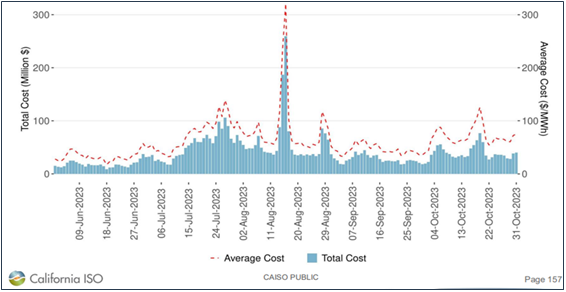
image-20251216151820-1.png

If a VOLL had been in place during that August 16, 2023 event, total market costs would have reached into the?BILLIONs?of dollars.   

Moreover, VOLL would only make sense for wholesale electricity markets that do not include RA programs or markets – such as ERCOT – because such markets enable generators to capture the full cost of meeting reliability through energy prices. In contrast, LSEs in the CAISO BAA participate in the CPUC’s RA program (or self supply their own RA as their own ‘Local Regulatory Authority’) and generators receive significant revenues for providing reliability (via their availability) from capacity payments from bilateral RA agreements – well in advance of entering the CAISO markets. Generators with a Must Offer Obligation (MOO) in CAISO receive energy revenue through the integrated forward market (real-time and day-ahead) and through RA capacity payments. The RA capacity payments capture the cost of reliability and fully cover the difference between costs and energy market revenues, which would then essentially be double counted through a costly VOLL. The RA capacity payments already provide the “missing money” that the energy market revenues do not provide. If CAISO were to allow prices to increase up to a VOLL, the CPUC would then need to consider whether to eliminate the RA capacity payments to avoid double-paying for VOLL both in RA capacity and CAISO scarcity pricing.  

The CPUC’s RA program establishes an RA requirement to meet a PRM based on loss of load expectation calculations. In doing so, the CPUC RA program already establishes demand in the bilateral RA market for capacity to provide reliability at a level that should ensure avoiding load losses.?Additional capacity requirements over and above the CPUC’s RA requirements should be handled as extreme and rare events (well outside of planning models): There is no need to make a “market product” using VOLL to pay for their availability for extreme events. 

Finally, the calculation of a VOLL metric is based on numerous assumptions concerning how customers value electricity reliability, and each of these assumptions will differ depending on the market in question, customer class, type of market, econometric issues, etc. It would be difficult, if not impossible, to develop a VOLL metric that fairly and accurately applies to all the non-homogenous customers spread across a climatically and geographically diverse regional market. 

2. Does your organization support the concept of an “Energy Supply Margin” mechanism as a viable alternative to creating a new reserve product? If the ISO adopts this approach, how should “available supply” be defined (e.g., time horizon, transmission constraints)?
The working group discussed a concept for an "Energy Supply Margin" mechanism, where a scarcity price is calculated based on the margin of available supply relative to demand.

No comments at this time. 

3. At what level should scarcity be measured and priced (footprint, BAA, nodal)? Please explain your reasoning and any implementation considerations.
The working group discussed applying scarcity pricing at the footprint level, the BAA level, or potentially the nodal level.

?See response to 1. above.?? 

4. Please provide any other feedback on the November 10 and 20 working group discussions not covered above.

?See response to 1. above.?? 

5. Are there any specific topics or questions you would recommend the working group address next?

?See response to 1. above.?? 

California Public Utilities Commission - Public Advocates Office
Submitted 12/12/2025, 03:18 pm

Contact

Patrick Cunningham (patrick.cunningham@cpuc.ca.gov)

Karl Dunkle Werner (karl.dunklewerner@cpuc.ca.gov)

1. Please summarize your organization’s overall stance on comprehensive scarcity pricing proposals.

The Public Advocates Office at the California Public Utilities Commission (Cal Advocates) is the independent ratepayer advocate at the California Public Utilities Commission (CPUC).  Our goal is to ensure that California ratepayers have affordable, safe, and reliable utility services while advancing the state’s environmental goals.

In the comments below, Cal Advocates provides the following responses:

  • The California Independent System Operator Corporation (CAISO) should develop and implement incremental scarcity pricing components that the CAISO previously considered,[1] and delay its development of a comprehensive design until after the CAISO implements the Extended Day Ahead Market (EDAM);
  • The CAISO’s development of a scarcity price mechanism should consider the effectiveness of such a mechanism to attract additional supply or responsive demand to the CAISO day-ahead and real-time markets;
  • If the CAISO plans to use a supply margin in scarcity pricing design, then the CAISO should ensure the design assumptions for future scarce hours are accurate; and
  • The CAISO should consider the policy landscape – including ongoing CPUC processes – that may also be developing price-responsive demand tools.

Schedule

The CAISO proposes to split the Price Formation Enhancement (PFE) process into two tracks: one track for the incremental policies in the CAISO’s Straw Proposal and a second for stakeholders to develop comprehensive scarcity pricing.[2]  The CAISO also proposes to delay additional scarcity pricing designs until development processes begin for flexible ramping products and ancillary services enhancements.[3]  The CAISO proposes to develop the two tracks in parallel and seek final governance approval of both tracks simultaneously.  Cal Advocates is not aware of any argument from the CAISO or any stakeholder that supports the CAISO’s suggestion that it hold either of the tracks until the CAISO can implement them together.

The Straw Proposal’s proposed incremental changes would improve price consistency during load shed, which would provide reasonable measures to attract and retain supply during emergencies.[4]  At the November 10, 2025 workshop, Southern California Edison Company presented on behalf of a group of load-serving entities (the Joint LSE Presentation).[5]  The Joint LSE Presentation states that the CAISO should move forward with consideration of the Straw Proposal, then pause other PFE development until the market has more experience with the policy changes and uncertainty associated with the CAISO’s implementation of EDAM.[6]  Cal Advocates supports both of these pricing recommendations.[7]  Cal Advocates also agrees with the Joint LSE Presentation statement that stakeholders do not know how the new EDAM uncertainty products will affect energy prices during scarcity conditions.[8]  Therefore, it would be prudent for the CAISO to wait until data becomes available before it attempts to design and evaluate new market structures.

Substantial changes to scarcity price designs would take significant time to develop.  The CAISO staff have noted a willingness to move consideration of the Straw Proposal forward if a more comprehensive scarcity price design faces delays.  Such delays are extremely likely given the course of this initiative and the start of EDAM.  Accordingly, rather than wait for the delay to manifest, the CAISO should simply move forward with its consideration of the Straw Proposal and delay comprehensive scarcity price designs until the CAISO and stakeholders have experience with EDAM.

Principles for Comprehensive Reforms to Scarcity Pricing

The CAISO presented several theoretical concepts on what scarcity pricing should provide and the following four points on what scarcity pricing “must” include:[9]

  1. A scarcity metric/trigger to detect when available supply does not meet needs,
  2. A reliability value metric that represents the cost of load shedding,
  3. A price formation mechanism that reflects reserve scarcity into market prices that reflect reliability risk,
  4. Forward-looking price signals that rise ahead of scarcity risk.

Cal Advocates is concerned that the four design principles above do not consider the effectiveness of scarcity pricing to attract additional supply and load reduction resources.  Rather, these principles focus on determining a reliability value and informing market prices – which may only increase supplier rents without attracting more energy or responsive load resources to avoid load shedding.  A scarcity pricing design should focus on attracting additional supply and load response beyond what is already committed or obligated to be provided to the CAISO energy markets.[10]  Otherwise, ratepayers may be charged significant additional costs with no reliability benefit.[11]  Similarly, the timing of energy-limited resources may be driven by prices; but here, relative prices are far more important than absolute price levels.  For example, prices do not have to be above existing bid caps for batteries to achieve the optimal pattern of charging and discharging.

If the CAISO pursues any scarcity price designs, it must consider whether those designs effectively attract supply and demand to address scarcity situations, above and beyond the effects of existing policies.  The CAISO market and local regulatory authorities (LRAs) already include designs that aim to ensure resource availability (such as RA programs).  The CAISO market also hosts some price-responsive demand (including demand bids, low-priority exports, curtailable load, and demand response programs).  Any scarcity pricing change should be based on the primary principle that the change would attract additional reliability resources beyond resources that are already committed to the market.

Additionally, Cal Advocates agrees with the recommendations in the Joint LSE Presentation that a scarcity price mechanism is not the appropriate tool to encourage investment in new resources.[12]  In the short run, this role is filled by the RA process.  In the long run, substantial new resources are already awaiting interconnection to the CAISO grid.  The CPUC, the largest LRA in the CAISO market, regularly enforces new resource procurement requirements.[13]


[1] CAISO, Price Formation Enhancements – BAA-Level MPM and Scarcity Pricing Straw Proposal, August 22, 2025 (Straw Proposal).  Available at: https://stakeholdercenter.caiso.com/InitiativeDocuments/StrawProposal-Price-Formation-Enhancements-BAA-Level-MPM-Scarcity-Pricing.pdf.

[2] CAISO, Price Formation Enhancements – Scarcity Pricing, November 20, 2025 (November 20 Workshop Slides) at 7.  Available at: https://stakeholdercenter.caiso.com/InitiativeDocuments/Presentation-Price-Formation-Enhancements-Nov-20-2025.pdf.

[3] Straw Proposal at 46.

[4] Cal Advocates continues to support Option 1 in the Straw Proposal, the in-market price formation process, for calculating prices during load shed events.  See Straw Proposal at 51.

[5] Price Formation Enhancements Phase 2 Joint LSEs – Scarcity Pricing, November 10, 2025 (Joint LSE Presentation).  Available at: https://stakeholdercenter.caiso.com/InitiativeDocuments/SCE-Presentation-Price-Formation-Enhancements-Nov10-2025.pdf.

[6] Joint LSE Presentation at 2-3.

[7] Neither the CAISO nor stakeholders have raised specific concerns about implementing these separately.  The stakeholders who argue against the recommendations in the Joint LSE Presentation raise concerns about delays to the more substantial PFE they would like to see.  These stakeholders do not identify any specific issues or concerns with the more modest changes in the Straw Proposal. For example, Calpine Corporation (at 44:00) and Western Power Trading Forum (WPTF) (at 49:30).  These stakeholders highlight the pairing of Balancing Authority Area (BAA) market power mitigation with scarcity pricing, but no stakeholders verbally objected to moving ahead with the Straw Proposal.  CAISO, Nov 20, 2025 – Price Formation Enhancements, accessed December 2, 2025.  Recording available at: https://youtu.be/Dhq1lTshYZM.

[8] Joint LSE Presentation at 5.

[9] November 20 Workshop Slides at 10.

[10] That is, a scarcity pricing design should attract more generation that was not already awarded for generation in the day-ahead and real-time markets.  Resource adequacy (RA) resources shown in the CAISO BAA are already obligated to offer their generation.  The CAISO should address any shortfalls RA incentives in the ongoing resource adequacy modelling and program design initiative.

[11] In previous discussions, the CAISO has repeatedly pointed to the Mid-Continent Independent System Operator’s (MISO) operational reserve demand curve (ORDC) and value of lost load (VOLL) design that would enable MISO market prices to reach up to $35,000/megawatt hour (Straw Proposal at 33).  That price is more than seventeen times higher than the highest real-time dispatch price reached during the September 2022 heatwave when the CAISO reached its record load while avoiding load shedding.  CAISO, Summer Market Performance Report Sept 2022, November 2, 2022 at 56.  Available at: https://www.caiso.com/Documents/SummerMarketPerformanceReportforSeptember2022.pdf.

[12] Joint LSE Presentation at 4.

[13] Since 2019, the CPUC’s Integrated Resource Planning proceeding has ordered 18,800 megawatts of new resources to be procured by its LSEs through 2028.  CPUC, Summary of Compliance with Integrated Resource Planning (IRP) Order D.19-11-016 and Mid Term Reliability (MTR) D.21-06-035 Procurement, October 9, 2024 at 5.  Available at: https://www.cpuc.ca.gov/-/media/cpuc-website/divisions/energy-division/documents/integrated-resource-plan-and-long-term-procurement-plan-irp-ltpp/irp12123compliancereport.pdf.

2. Does your organization support the concept of an “Energy Supply Margin” mechanism as a viable alternative to creating a new reserve product? If the ISO adopts this approach, how should “available supply” be defined (e.g., time horizon, transmission constraints)?
The working group discussed a concept for an "Energy Supply Margin" mechanism, where a scarcity price is calculated based on the margin of available supply relative to demand.

Cal Advocates is concerned that the current supply margin proposal would directly increase prices but is only speculative in its aims of providing smooth, predictable price increases ahead of scarcity events.  The proposed supply margin approach would increase prices with a “scarcity pricing adder” that is based on the difference between current requirements and available supply.[1]  This adder’s direct effect would be to increase prices during periods where the margin is small.  The adder’s intended indirect effect is to signal to market participants that they should be ready to perform, “as supplies begin to tighten.”[2]

The CAISO and WPTF’s concepts that consider current supply margin to forecast future scarcity include a strong implicit assumption about correlation between the contemporaneous supply margin and shortage risk in the coming hours.  If the CAISO develops any kind of supply margin proposal, the CAISO should investigate when that assumption is true and when it is not.  In some cases, tight margins in hour ending (HE) 17 may be a good predictor for even tighter conditions in HE 19, but because of solar production, the same is unlikely to be true for HE 7 and HE 9.  Any proposal that attempts to use conditions in a given hour as an indication of scarcity in the coming hours should consider when that prediction will be good and when it will perform poorly.


[1] Gridwell Consulting on behalf of WPTF, Supply Margin Scarcity Pricing Design – Conceptual Framework, November 10, 2025 (WPTF slides) at 6.  Available at: https://stakeholdercenter.caiso.com/InitiativeDocuments/Gridwell-Consulting-WPTF-Presentation-Price-Formation-Enhancements-Nov10-2025.pdf.

[2] WPTF slides at 5 and 10.

3. At what level should scarcity be measured and priced (footprint, BAA, nodal)? Please explain your reasoning and any implementation considerations.
The working group discussed applying scarcity pricing at the footprint level, the BAA level, or potentially the nodal level.

Cal Advocates provides no response to this topic at this time.

4. Please provide any other feedback on the November 10 and 20 working group discussions not covered above.

Scarcity Pricing Development Should Consider non-CAISO Price-Responsive Policies and Programs

The CAISO should account for the existing policy landscape when it considers designs that aim to address scarcity via changes in price-responsive demand.  As one example, the CPUC may adopt a retail rate design structure that includes a component that reflects wholesale electricity prices from day-ahead and/or real-time markets.[1]  These rate structures may or may not lead to the price-responsiveness some stakeholders described in the November 20, 2025 workshop.  The CAISO should consider price-responsive programs implemented by LRAs in the CAISO BAA and in the EDAM footprint when it determines the need for and design of any scarcity pricing mechanism.

Scarcity Pricing Should Not Provide Availability Incentives to RA Resources

RA resources are obligated to make themselves available to the CAISO market through economic bids or self-schedules.  Scarcity pricing mechanisms would not, and should not, presume to attract additional RA supply to the market since RA supply is already obligated to be available to the CAISO markets.  As mentioned above, the CAISO market already expects obligated and committed supply to be available for dispatch.  Therefore, the CAISO should consider scarcity pricing mechanisms that are designed to attract non-obligated and non-committed supply and load responsive resources.


[1] For more information on the CPUC’s dynamic rates proceeding, see the docket for Rulemaking 22-07-005, Order Instituting Rulemaking to Advance Demand Flexibility Through Electric Rates, available at: https://apps.cpuc.ca.gov/apex/f?p=401:56::::RP,57,RIR:P5_PROCEEDING_SELECT:R2207005.

5. Are there any specific topics or questions you would recommend the working group address next?

Cal Advocates provides no additional recommendations at this time.

Calpine Corporation
Submitted 12/12/2025, 02:41 pm

Contact

Chris Devon (chris.devon@calpine.com)

1. Please summarize your organization’s overall stance on comprehensive scarcity pricing proposals.

Calpine appreciates the opportunity to comment on CAISO’s continued work on scarcity pricing and strongly supports implementing a robust scarcity pricing framework in CAISO markets. Scarcity pricing is not optional, it is a foundational market enhancement that ensures accurate price formation, strengthens reliability signals, and reduces reliance on administrative actions.

Since the August 2020 load-shed events, stakeholders have consistently highlighted that CAISO lacks a proactive scarcity pricing design. Current proposals still delay scarcity signals until extreme conditions, which undermines reliability and import incentives. Limiting scarcity pricing to load-shed events is insufficient.

Calpine strongly support moving beyond “event-only” scarcity constructs toward calibrated, market-based signals that rise before emergencies.  These approaches are in line with best practices across most other organized markets. These reforms are essential for reliability and efficient price formation as CAISO approaches tight supply conditions, rather than waiting until emergencies are eminent and relying on out-of-market actions. 

2. Does your organization support the concept of an “Energy Supply Margin” mechanism as a viable alternative to creating a new reserve product? If the ISO adopts this approach, how should “available supply” be defined (e.g., time horizon, transmission constraints)?
The working group discussed a concept for an "Energy Supply Margin" mechanism, where a scarcity price is calculated based on the margin of available supply relative to demand.

Calpine supports the concept of an Energy Supply Margin mechanism as a viable alternative to creating a new reserve product. New reserve products may increase implementation complexity and overlap with existing and planned products. An Energy Supply Margin approach can provide a gradual, economically grounded price signal as available supply decreases, consistent with Operating Reserve Demand Curve (ORDC) principles used in other organized markets. Applying gradual scarcity pricing approach will reduce volatility while still improving incentives for additional supply to be made available, including imports and flexible resources. It would also reduce the reliance on administrative actions that distort market outcomes.

A robust scarcity pricing horizon for CAISO should be no less than 135 minutes, aligning with the Short-Term Unit Commitment (STUC) window so the market properly values resources that can realistically respond in the near term.

Available supply calculations should reflect actual deliverable capacity to avoid overstating system capability and mispricing scarcity conditions. This approach should include downward adjustments to reflect the probability of undeliverable resources. Such an adjustment does not necessitate complex deployment scenarios, rather simple estimations based on transmission constraints and resource characteristics should be sufficient. This adjustment would ensure scarcity pricing reflects actual deliverable capacity, improving the accuracy and efficiency of resulting pricing outcomes.

3. At what level should scarcity be measured and priced (footprint, BAA, nodal)? Please explain your reasoning and any implementation considerations.
The working group discussed applying scarcity pricing at the footprint level, the BAA level, or potentially the nodal level.

Calpine supports applying scarcity pricing at the BAA level, as opposed to at the nodal, or footprint wide level. This approach would align with the Extended Day Ahead Market (EDAM) policy decision to maintain separate marginal costs of energy and respects regional differences in supply conditions. Pricing scarcity at the BAA level ensures signals are targeted to the area experiencing tight conditions and helps avoid distorting EDAM transfers when congestion isolates BAAs.

4. Please provide any other feedback on the November 10 and 20 working group discussions not covered above.

Some stakeholders have suggested deferring scarcity pricing reforms due to resource constraints and prioritization preferences. These objections are not grounded in market design principles or reliability needs. Scarcity pricing is a core market enhancement that has been long-delayed. It should not be considered a discretionary feature. Delaying implementation perpetuates a design flaw that undermines reliability and efficient price formation.

Over the past five years, many market participants have accurately emphasized that scarcity pricing is essential to align incentives and reduce reliance on out-of-market actions. These positions reflect sound economic theory and operational experience, unlike arguments to delay or defer this effort based on organizational priorities. CAISO should proceed with this critical policy development effort and continue its planned pathway to prioritize implementation of real-time scarcity pricing with pre-emergency triggers and a clear roadmap toward ORDC-based design.

Calpine understands the priorities and emphasis CAISO has rightfully placed on its EDAM and Day Ahead Market Enhancements (DAME) efforts over the past several years. Some stakeholders have highlighted the implementations of these initiatives necessitate a sharp focus and energy from their respective teams to prepare for the pending go-live. If CAISO determines that scarcity pricing reforms cannot proceed immediately, Calpine strongly recommends CAISO commit to resuming this effort in earnest immediately following the initial implementation of EDAM and DAME. Scarcity pricing remains a critical market enhancement, and any delay should be explicitly time-bound with a clear restart timeline to ensure these reforms are not deferred indefinitely. Post-EDAM and DAME go-live provides a natural milestone to reengage and prioritize design and implementation of more robust real-time scarcity pricing.

5. Are there any specific topics or questions you would recommend the working group address next?

Joint EIM Entities (BANC, IPC, PAC, PGE, PNM)
Submitted 12/12/2025, 12:49 pm

Submitted on behalf of
Balancing Authority of Northern California, Idaho Power Company, PacifiCorp, Portland General Electric, and Public Service of New Mexico

Contact

Kalia Savage (kalia.savage@pgn.com)

1. Please summarize your organization’s overall stance on comprehensive scarcity pricing proposals.

Balancing Authority of Northern California, Idaho Power Company, PacifiCorp, Portland General Electric, and Public Service of New Mexico (“Joint Commenters”) recommend that the CAISO pause discussion of any comprehensive scarcity pricing construct until after EDAM and DAME have reached operational maturity and their real-world performance is well understood. This sequence is essential to avoid introducing a major price formation redesign into a market environment that is still undergoing foundational structural changes.

The Joint Commenters note the CAISO’s effort to reopen a structured discussion on comprehensive scarcity pricing concepts, including the comparison of ORDC-style reserve products and an energy supply-margin mechanism. These discussions highlight the long-term importance of aligning market prices with evolving reliability conditions across the broader regional footprint. However, pursuing a forward-looking scarcity construct at this stage presents material risks, particularly given the number of interdependent EDAM and DAME elements that remain in flux.

As EIM Entities who are considering and/or preparing for EDAM participation, the Joint Commenters emphasize that any major reform to price formation should occur only within a stable operational environment and with a clear understanding of how new mechanisms will interact with EDAM transfers, DAME schedules, BAA-level coordination, and associated market power mitigation structures. At present, several core components of day-ahead and real-time coordination – such as interchange modeling, BAA-level responsibilities, and mitigation treatments – are still progressing toward their final form, and their interactions with a new scarcity pricing construct cannot yet be reliably assessed.

For these reasons, the Joint Commenters recommend limiting near-term efforts to implementation of (1) the CAISO’s BAA-level MPM proposal and (2) the incremental improvements to pricing in scarcity conditions. Development of any forward-looking scarcity mechanism – whether reserve-based or supply margin-based – should be deferred to a later phase once EDAM has demonstrated consistent operational performance and its broader system impacts are better understood. This approach minimizes implementation risk, supports stable EDAM onboarding, and preserves the ability to evaluate comprehensive scarcity pricing reforms using EDAM operational experience rather than pre-EDAM implementation modeling alone.

2. Does your organization support the concept of an “Energy Supply Margin” mechanism as a viable alternative to creating a new reserve product? If the ISO adopts this approach, how should “available supply” be defined (e.g., time horizon, transmission constraints)?
The working group discussed a concept for an "Energy Supply Margin" mechanism, where a scarcity price is calculated based on the margin of available supply relative to demand.

N/A

3. At what level should scarcity be measured and priced (footprint, BAA, nodal)? Please explain your reasoning and any implementation considerations.
The working group discussed applying scarcity pricing at the footprint level, the BAA level, or potentially the nodal level.

N/A

4. Please provide any other feedback on the November 10 and 20 working group discussions not covered above.

N/A

5. Are there any specific topics or questions you would recommend the working group address next?

N/A

LADWP
Submitted 12/11/2025, 11:15 am

Submitted on behalf of
LADWP

Contact

Stuart Kelly (skelly@utilicast.com)

1. Please summarize your organization’s overall stance on comprehensive scarcity pricing proposals.

LADWP asks that comprehensive reforms be delayed until after DAME/EDAM implementation.  LADWP would like CAISO to focus on enhancing the market power mitigation framework which LADWP believes is critical for EDAM implementation, and delay comprehensive reforms to price formation enhancements until after DAME/EDAM go-live.

The comprehensive scarcity pricing framework requires dedicated time from all stakeholder groups. It should not be driven through while other major initiatives like EDAM are underway and close to going live.  Scarcity pricing has large implications that impact market dispatch and should be thought out carefully rather than rushed. For added perspective, the stakeholder community is preparing for an EDAM congestion revenue initiative, analyzing intertie scheduling changes from EDAM, and working on the implementation changes caused by EDAM.  Additionally, the footprint of the market is on the verge of major changes with future implementations and potential participant exits. This is not the appropriate time to discuss additional large-scale market changes when stakeholders lack the data and understanding of the impacts of the new Day Ahead Market design. Decisions and stakeholder comments are better informed by market performance data of which none currently exists. LADWP believes it would be best to get the comprehensive scarcity pricing design right the first time rather than have to continuously improve because of a lack of data to inform comments and market design decisions at this time

2. Does your organization support the concept of an “Energy Supply Margin” mechanism as a viable alternative to creating a new reserve product? If the ISO adopts this approach, how should “available supply” be defined (e.g., time horizon, transmission constraints)?
The working group discussed a concept for an "Energy Supply Margin" mechanism, where a scarcity price is calculated based on the margin of available supply relative to demand.
3. At what level should scarcity be measured and priced (footprint, BAA, nodal)? Please explain your reasoning and any implementation considerations.
The working group discussed applying scarcity pricing at the footprint level, the BAA level, or potentially the nodal level.
4. Please provide any other feedback on the November 10 and 20 working group discussions not covered above.
5. Are there any specific topics or questions you would recommend the working group address next?

Middle River Power, LLC
Submitted 12/12/2025, 03:57 pm

Contact

Brian Theaker (btheaker@mrpgenco.com)

1. Please summarize your organization’s overall stance on comprehensive scarcity pricing proposals.

MRP supports the CAISO’s latest proposal to wait until the CAISO and stakeholders have developed balanced proposals for both scarcity pricing and system market power mitigation before simultaneously bringing those proposals to the CAISO Board of Governors.[1] 

For several reasons, MRP objects to the proposal by the joint Load Serving Entities (“LSEs”) to defer further work on scarcity pricing until a year after the implementation of the Day-Ahead Market Enhancements (“DAME”) and Extended Day-Ahead Market (EDAM”).   First, on the last working group call, the joint LSEs argued that the recent addition of 13 GW of battery energy storage nameplate capacity makes it unlikely that the CAISO would encounter scarcity in the near future. The addition of 13 GW of new battery capacity would also make it unlikely that any entity would be able to exert system-level market power, even using the stringent three pivotal supplier test.  The addition of this new capacity opens the door for the CAISO to pursue system-level market power mitigation and scarcity pricing as a balanced pair without the need to implement system market power mitigation well before scarcity pricing.  Second, the CAISO should not accept the theory that the implementation of DAME and EDAM will tax stakeholder resources to the point that CAISO can move forward only with system market mitigation now.  Ironically, the entities that are asserting resource issues are those with the largest rate-base supported staffs.  Finally, the Western Power Trading Forum’s Energy Supply Margin (“ESM”) conceptual proposal offers a way forward for meaningful scarcity pricing that depends neither on the CAISO creating a new reserve product nor on the CAISO procuring ancillary services in BAA areas outside the CAISO BAA.  For these reasons, MRP encourages the CAISO to stay the course it presented at the November working group meetings (namely, bringing a balanced package with both scarcity pricing and system market power mitigation to its Board) and reject calls to move forward only with market power mitigation and defer work on scarcity pricing.   


[1] See, e.g., slide 7 of the CAISO’s presentation for the November 20, 2025 working group meeting, which shows market power mitigation and scarcity pricing proceeding on separate tracks before coming together for simultaneous presentation to the CAISO Board of Governors. 

2. Does your organization support the concept of an “Energy Supply Margin” mechanism as a viable alternative to creating a new reserve product? If the ISO adopts this approach, how should “available supply” be defined (e.g., time horizon, transmission constraints)?
The working group discussed a concept for an "Energy Supply Margin" mechanism, where a scarcity price is calculated based on the margin of available supply relative to demand.

Yes, MRP supports the concept of an “Energy Supply Margin” as not only a viable alternative to creating a new reserve product, but as a preferred alternative to creating a new reserve product.  MRP expects that ESM-based scarcity pricing could be implemented much more quickly than scarcity pricing based on either a new reserve product or even based on existing ancillary service products being procured by the CAISO for other EDAM BAAs.

3. At what level should scarcity be measured and priced (footprint, BAA, nodal)? Please explain your reasoning and any implementation considerations.
The working group discussed applying scarcity pricing at the footprint level, the BAA level, or potentially the nodal level.

MRP supports implementing scarcity pricing at the Balancing Authority Area (“BAA”) level.  Implementing scarcity pricing at the nodal level seems unnecessarily granular and implementing scarcity pricing at the EDAM footprint seems unworkably expansive.  


4. Please provide any other feedback on the November 10 and 20 working group discussions not covered above.

 MRP has no other comments.

5. Are there any specific topics or questions you would recommend the working group address next?

 MRP has no other comments.

Northern California Power Agency
Submitted 12/12/2025, 11:10 am

Contact

Tony Zimmer (tony.zimmer@ncpa.com)

1. Please summarize your organization’s overall stance on comprehensive scarcity pricing proposals.

NCPA agrees with CAISO’s conclusion in the Problem Statements that “the market’s reserve portfolio cannot fully support comprehensive scarcity pricing across the footprint” due to limitations in ancillary service and flexible ramping product designs. Before attempting to address comprehensive scarcity pricing proposals, ISO must first implement the following enhancements to ancillary service procurement:


  • Deliverability tests for AS
  • Full re-optimization of AS in real time
  • Eliminate the cascading procurement between regulation and operating reserves since these two A/S groups serve separate purposes and therefore should not be substituted for one another. 
  • Allow market to procure AS for CAISO BA and EDAM BAs


NCPA does not support development of yet another reserve product or mathematically similar “latent margin” construct. NCPA considers those as half measure that are not worth the time to implement. CAISO time should be spent addressing the important aspect, which is the AS limitations described above.

2. Does your organization support the concept of an “Energy Supply Margin” mechanism as a viable alternative to creating a new reserve product? If the ISO adopts this approach, how should “available supply” be defined (e.g., time horizon, transmission constraints)?
The working group discussed a concept for an "Energy Supply Margin" mechanism, where a scarcity price is calculated based on the margin of available supply relative to demand.

No, please see comment 1.

3. At what level should scarcity be measured and priced (footprint, BAA, nodal)? Please explain your reasoning and any implementation considerations.
The working group discussed applying scarcity pricing at the footprint level, the BAA level, or potentially the nodal level.

This will need to be revisited after A/S enhancements are in place.

4. Please provide any other feedback on the November 10 and 20 working group discussions not covered above.

NCPA supports the ISO LSE comments shared at the November 10 working group discussions. While a range of views were expressed at these discussions, the ISO LSE comments carry particularly heavy weight because those are the entities with rate payers whose both (1) have a direct interest in affordable and reliable power, and (2) will be footing the bill for implementing any scarcity pricing constructs. NCPA believes the current market caps are sufficient during scarce conditions.


NCPA continues to oppose the Value of Lost Load (VOLL) concept. Anchoring market penalty prices to a (VOLL) metric instead of bid caps will increase costs to ratepayers, but there is no evidence showing that it would advance the ultimate goals of reliability and affordability or increase supply. VOLL metrics are inherently subjective because the assumptions and inputs cause the results to vary widely, and NCPA agrees that as proposed it is just an administrative construct by another name. The current $2,000 offer caps sufficiently meet or exceed most, if not all, resources’ variable costs, and generators can exceed the caps if they can justify bids to FERC. Moreover, as discussed in the presentation, there are unique challenges to CAISO developing VOLL that make this far from a mere copy-and-paste of MISO’s implementation of VOLL.  Finally, NCPA is skeptical that increasing prices will bring any material incremental real supply to the market. There could potentially be some justification for Demand Response prices in excess of $2000 based on those programs’ designs, but Demand Response providers can already seek to recover costs in excess of caps at FERC. In any case, many of these resources are plagued with performance issues that higher prices will do nothing to remedy. Rather, introduction of VOLL could lead to market power and/or manipulation, as there is the potential that unscrupulous sellers could withhold capacity to take advantages of the possibility of the higher prices under this construct.


NCPA does not believe that current emergency actions such as emergency demand response programs, strategic reserve dispatch, etc. properly reflect scarcity in market prices. Many demand response resources are notoriously unreliable and glitchy. Strategic reserve dispatches can be made for any BAA in California, not just for CAISO’s benefit. CAISO must resolve persistent price divergence observed during emergency conditions. CAISO should continue evaluating the effectiveness of convergence bidding and its potential detriments to the market, especially during scarcity conditions.


While there are clear opportunities for improvements, NCPA supports incremental improvements on Price Formation generally and Scarcity Pricing specifically at this time. NCPA is skeptical that it is feasible to implement many of the large-scale concepts being considered in this initiative in a just and reasonable way. NCPA suggests evaluating the impacts DAME and EDAM has on price formation and then moving forward accordingly, starting with AS enhancements. Similarly, CAISO is currently pursuing the Resource Adequacy Modeling and Program Design initiative to look at ways that program can be modified to ensure sufficient supply is available in order to reduce intervals of scarcity conditions. If those efforts bear fruit, Scarcity Pricing changes may not be necessary. At minimum, the details of any large-scale Price Formation and/or Scarcity Pricing reforms should take into account how these other reforms are operating in practice after they are implemented.

5. Are there any specific topics or questions you would recommend the working group address next?

None at this time.

NV Energy
Submitted 12/12/2025, 12:48 pm

Contact

Lindsey Schlekeway (lindsey.schlekeway@nvenergy.com)

1. Please summarize your organization’s overall stance on comprehensive scarcity pricing proposals.

NV Energy opposes the current proposed scope for the price formation enhancements.  CAISO should focus on enhancing the market power mitigation framework which NV Energy believes is further along in design and should not be coupled with a comprehensive scarcity pricing design. The comprehensive scarcity pricing framework is very important and deserves dedicated stakeholder time. It should not compete for attention with numerous other major initiatives that are currently underway, in implementation, or about to begin.  Scarcity pricing has large implications that impact market dispatch and should be thought out carefully rather than rushed. For perspective, the stakeholder community is preparing for an EDAM congestion revenue initiative, analyzing intertie scheduling changes from EDAM, and working on the implementation for changes from EDAM.  Additionally, the footprint of the market is on the verge of major changes with future implementations and potential participant exits. This is not the appropriate time to discuss additional large-scale market changes when stakeholders lack the data and understanding of the impacts of the new Day Ahead Market design. Decisions and stakeholder comments are better informed by market performance data which none currently exists. NV Energy believes it would be best to get the comprehensive scarcity pricing design right the first time rather than have to continuously improve because we lacked data to inform comments and market design decisions at this time.

2. Does your organization support the concept of an “Energy Supply Margin” mechanism as a viable alternative to creating a new reserve product? If the ISO adopts this approach, how should “available supply” be defined (e.g., time horizon, transmission constraints)?
The working group discussed a concept for an "Energy Supply Margin" mechanism, where a scarcity price is calculated based on the margin of available supply relative to demand.
3. At what level should scarcity be measured and priced (footprint, BAA, nodal)? Please explain your reasoning and any implementation considerations.
The working group discussed applying scarcity pricing at the footprint level, the BAA level, or potentially the nodal level.
4. Please provide any other feedback on the November 10 and 20 working group discussions not covered above.
5. Are there any specific topics or questions you would recommend the working group address next?

Pacific Gas & Electric
Submitted 12/12/2025, 01:43 pm

Contact

Adeline Lassource (Adeline.Lassource@pge.com)

1. Please summarize your organization’s overall stance on comprehensive scarcity pricing proposals.

PG&E appreciates the opportunity to provide comments on the CAISO Price Formation Enhancements initiative, specifically regarding scarcity pricing.

At this time, PG&E does not support further policy development on comprehensive scarcity pricing.  

We believe further discussion of comprehensive scarcity pricing should be postponed, as there is not an identified, urgent need for comprehensive reform.  We recommend CAISO delay any further development until the Extended Day-Ahead Market (EDAM) is fully implemented and live for at least one year. Introducing comprehensive scarcity pricing would be premature until there is sufficient experience with imbalance reserves and EDAM.

For more details, PG&E is sharing the joint LSEs letter sent to the WEM Governing Body meeting of October 28, 2025 (link: https://www.westernenergymarkets.com/documents/jointlsespubliccommentletter-priceformationenhancementsinitiative-oct28-2025.pdf). 

Stakeholders have already spent considerable time evaluating various design reforms, and the major options have been ruled out at this time. Continued effort on price formation will jeopardize stakeholder attention, focus, and time commitment to other more critical efforts (i.e., EDAM/DAME Implementation, RSE, and DDEMI). Since 2020, there have been no significant issues, and the CAISO market is experiencing tremendous change including the integration of new resources (i.e. renewables and batteries), the implementation of EDAM and DAME, wheeling priority changes, and enhancements to the WEIM Resource Sufficiency Evaluation. 

PG&E continues to support the limited incremental improvements and enhancements outlined in the current straw proposal (see PG&E’s comments submitted in September: California ISO - All comments) and would like to see that process complete quickly – if acceptable to the stakeholder community.

2. Does your organization support the concept of an “Energy Supply Margin” mechanism as a viable alternative to creating a new reserve product? If the ISO adopts this approach, how should “available supply” be defined (e.g., time horizon, transmission constraints)?
The working group discussed a concept for an "Energy Supply Margin" mechanism, where a scarcity price is calculated based on the margin of available supply relative to demand.

See PG&E’s comments in question 1.

3. At what level should scarcity be measured and priced (footprint, BAA, nodal)? Please explain your reasoning and any implementation considerations.
The working group discussed applying scarcity pricing at the footprint level, the BAA level, or potentially the nodal level.

See PG&E’s comments in question 1.

4. Please provide any other feedback on the November 10 and 20 working group discussions not covered above.

No comments at this time.

5. Are there any specific topics or questions you would recommend the working group address next?

No comments at this time.

PacifiCorp
Submitted 12/12/2025, 03:11 pm

Contact

Vijay Singh (vijay.singh@pacificorp.com)

1. Please summarize your organization’s overall stance on comprehensive scarcity pricing proposals.

PacifiCorp appreciates the CAISO’s leadership and stakeholders’ engagement on scarcity pricing and believes the robust conversations have been necessary for determining whether scarcity pricing is needed in the CAISO markets and how scarcity pricing should be designed. PacifiCorp does not believe the CAISO and stakeholders should pursue a comprehensive scarcity pricing design at this time for the reasons discussed below.


Comprehensive scarcity pricing does not have broad support among stakeholders


Meetings on November 10th and 20th demonstrated a distinct split among supply-side and load-serving stakeholders on the topic of a comprehensive scarcity pricing design. Stakeholders that represent suppliers favor a comprehensive design, while load-serving entities prefer a delay to prioritize the implementation activities of the Extended Day-Ahead Market (“EDAM”) and Day-Ahead Market Enhancements (“DAME”). This misalignment signals to PacifiCorp that now is not the right time to move forward with designing a comprehensive scarcity pricing design. Therefore, PacifiCorp recommends revisiting this topic after the EDAM and DAME have been implemented and price formation in the EDAM and WEIM is better understood. Comprehensive scarcity pricing reforms will be consequential and highly impactful for market participants, and so it is worth waiting until discussions can have full engagement from entities implementing the EDAM and DAME.


It's not clear what problems comprehensive scarcity pricing would solve


During discussions about scarcity pricing, there have been numerous benefits cited as reasons the CAISO markets need a better scarcity pricing design. Many of the referenced benefits seem to come from economic theory on improving the efficiency of electricity markets, while others point to pricing during the heatwave events in 2020 and 2022. However, it’s not clear to PacifiCorp whether the lack of a robust scarcity pricing design is causing real problems with the supply that’s available to the market in the short-term and the incentives for resource development in the long-term. PacifiCorp has not seen any data that suggests supply was not participating during past scarcity events that would have participated if prices were higher. Similarly, interconnection queues in the CAISO and western balancing authority areas (“BAAs”), and the buildout of storage resources in the past couple of years don’t indicate a lack of incentives for new resources to come online.


Furthermore, while prices did not gradually rise in past scarcity events, it’s not clear to PacifiCorp whether it was due to a lack of a scarcity pricing mechanism or current market designs. For example, one of the implications of having a resource sufficiency evaluation in the Western Energy Imbalance Market is that bids are submitted well in advance of the real-time market. Market participants only have the ability to change their market bids well in advance of the operating interval. In the Price Formation Enhancements initiative, discussions of scarcity pricing have focused on the CAISO’s lack of scarcity pricing design instead of designs in the WEIM that may make scarcity pricing ineffective anyway.


Stakeholders are focused on EDAM and DAME implementation, and other market design enhancements


Comprehensive scarcity pricing reform is a complex and impactful market design. A holistic design will require dedicated time and effort from stakeholders so that scarcity pricing delivers market benefits for all participants. Like many stakeholders, PacifiCorp’s priority is implementing the EDAM and DAME. The Company also believes stakeholders will need to be prepared to quickly develop any EDAM enhancements that address challenges that may arise after EDAM go-live. All of this is in addition to ongoing initiatives that are impactful and important to stakeholders. It would be a challenge for PacifiCorp to be fully involved in scarcity pricing reform at this time because it is a lower priority than the other initiatives and implementation that is happening now. Based on past conversations about scarcity pricing, it seems as though many other load-serving entities feel the same.  As such, PacifiCorp believes a better scarcity pricing design can be developed in the future when stakeholders have more bandwidth to give to the initiative.


Price formation post-EDAM go-live should be basis for scarcity pricing design


The EDAM and DAME will have price formation impact on both the day-ahead market and WEIM. Specifically, PacifiCorp believes the imbalance reserve product will impact the amount of supply available to be dispatched in the WEIM and will likely have complex interactions with the flexible ramping product and other current market designs. In PacifiCorp’s opinion, the impacts of the imbalance reserve product on price formation in the WEIM are not yet well understood. It is likely that price formation impacts won’t be well understood until market participants gain experience in the EDAM and WEIM with the imbalance reserve product. It is therefore difficult for PacifiCorp to understand (1) whether a scarcity pricing mechanism is needed for the WEIM and (2) what the design should be. EDAM experience and analysis of price formation in the WEIM after EDAM go-live should be used to inform future scarcity pricing conversations. PacifiCorp believes that a better scarcity pricing design will result from future discussions when market participants have the experience and data to make informed decisions about market designs.


In conclusion, a comprehensive scarcity pricing design in the CAISO markets may have benefits for market participants, but it is currently unclear whether those benefits warrant the time and effort required by stakeholders while EDAM and DAME implementation is ongoing. PacifiCorp recommends that discussions of a comprehensive scarcity pricing design are postponed until the EDAM is functioning stably, and critical issues from go-live are resolved. The number one priority for the CAISO and stakeholders right now is to successfully implement the EDAM and DAME, and to ensure the market is functioning adequately. Designing a complex and consequential market design like a scarcity pricing mechanism requires a level of participation from stakeholders that may not be feasible right now. Not only would designing a scarcity pricing mechanism take a lot of time and energy from stakeholders, it also does not seem like there is a clear consensus of whether a comprehensive scarcity pricing mechanism is needed for the CAISO markets. While PacifiCorp does not recommend future discussions about scarcity pricing start back from the beginning, CAISO and stakeholders should first work toward a common understanding of what the benefits of scarcity pricing are for the CAISO markets.  PacifiCorp believes that experience in the EDAM may also help stakeholders determine what a scarcity pricing mechanism for the CAISO markets should look like.

2. Does your organization support the concept of an “Energy Supply Margin” mechanism as a viable alternative to creating a new reserve product? If the ISO adopts this approach, how should “available supply” be defined (e.g., time horizon, transmission constraints)?
The working group discussed a concept for an "Energy Supply Margin" mechanism, where a scarcity price is calculated based on the margin of available supply relative to demand.
3. At what level should scarcity be measured and priced (footprint, BAA, nodal)? Please explain your reasoning and any implementation considerations.
The working group discussed applying scarcity pricing at the footprint level, the BAA level, or potentially the nodal level.
4. Please provide any other feedback on the November 10 and 20 working group discussions not covered above.
5. Are there any specific topics or questions you would recommend the working group address next?

PacifiCorp does not believe BAA-level market power mitigation (“MPM”) and the limited scarcity pricing proposals need to be linked with comprehensive scarcity pricing reform. BAA-level MPM has broad support among stakeholders and there is a clear path toward enhancements, specifically, the grouping methodology proposed by the CAISO. The grouping methodology will provide benefits to EDAM and WEIM entities by more fairly mitigating resource offers when large suppliers in an import-constrained BAA have the opportunity to exert market power. Policy discussions are now focused on details of the market design, and a final proposal on BAA-level MPM enhancements can likely be reached sometime in 2026. Similarly, for the limited scarcity pricing designs, there is broad support, and discussions are now focused on specific details of the design. This is not the case with comprehensive scarcity pricing reform, which does not currently have broad support and is not close to developing specific design details. PacifiCorp believes it is in the best interests of stakeholders to move forward with BAA-level MPM and the limited scarcity pricing designs while postponing the comprehensive scarcity pricing track of the Price Formation Enhancements initiative.

Public Generating Pool
Submitted 12/12/2025, 04:15 pm

Contact

Sibyl Geiselman (sgeiselman@publicgeneratingpool.com)

1. Please summarize your organization’s overall stance on comprehensive scarcity pricing proposals.

PGP is a collection of nine public utilities in Washington and Oregon. All nine PGP members own or purchase approximately 8,000 MW of non-federal generating resources, which is 96% carbon-free and 90% hydro. PGP members also purchase approximately 45% of the requirements power sold by the Bonneville Power Administration. We appreciate the opportunity to provide comments on this initiative.

PGP is supportive of ongoing efforts to establish a scarcity design that is compatible with the WEIM, EDAM, and CAISO markets including the important steps identified in the straw proposal which we see as urgently needed steps to improve price signals during emergency events. These steps, along with changes to the MPM framework included in the Straw Proposal appear to be supported by most stakeholders and represent significant progress on these critical issues.  PGP is concerned that continued work on refinements may delay the implementation of these meaningful design changes. PGP recommends adopting the progress already made by building on the straw proposal with improved and expanded emergency condition parameters and finalizing outstanding design questions in the BA mitigation prior to furthering the design concepts discussed on November 10th and 20th. This can be done in a way that leaves the door open for a supply-margin based scarcity proposal later on.

According to a recent E3 study sponsored in part by PGP, the Pacific Northwest region faces a potential for increased risk of supply shortfall in the coming years. Improved price signals and transparency during emergency events (even through clear ex-post settlement that ensures the price is at the cap when emergency actions are taken) could be critical to regional reliability in the short term. The pressure for improved market power mitigation and the fall-out and confusion around price formation and actual or perceived operator actions during recent reliability events 1] in CAISO-operated markets shows the importance of improved transparency and clear and easy to understand price formation during such events. Any improvements that avoid incorrect signals during emergency events, and/or improve signals to facilitate and encourage the best and highest use of emergency measures and performance of resources when challenges occur are critically important to implement sooner rather than later.

Given the complexity of any new scarcity proposal and the related implementation timeline, ongoing improvements to the Flexible Ramping Product, the introduction of the Imbalance reserve, and enhanced modeling and price formation anticipated to be implemented with the Extended Day Ahead Market, these immediate changes to get any “low hanging fruit” for appropriate pricing during emergency conditions, and to improve the market power mitigation framework should be the immediate focus. Further defining scarce conditions at the BA level, how to monitor them, and how they are triggered could support later design on the energy margin concept and should be seen as a logical first step to continue this dialogue.


[1] See, for example  "Review of January 2024 MLK Event and Myth Busting", Guillermo Bautista Alderete, Presented at the WEM Regional Issues Forum September 27, 2024. https://www.westernenergymarkets.com/documents/presentation-wemregionalissuesforumcrrs-caiso.pdf

2. Does your organization support the concept of an “Energy Supply Margin” mechanism as a viable alternative to creating a new reserve product? If the ISO adopts this approach, how should “available supply” be defined (e.g., time horizon, transmission constraints)?
The working group discussed a concept for an "Energy Supply Margin" mechanism, where a scarcity price is calculated based on the margin of available supply relative to demand.

PGP supports the concept of a BA-level available supply test that is compatible across market participant types, along with further definitions of what constitutes emergency action, or being “out” of supply, and what can be considered in such a margin.  PGP recommends the exploration of alignment of this concept with the resource sufficiency evaluation and emergency assistance program, and further exploration of broadly applicable definitions of what counts in any margin, and what constitutes emergency actions or scarcity conditions that align with improving the existing straw proposal and customer comments on expanding the concept. Additional definition of the straw proposal is a logical first step to defining the supply margin, as this determines what constitutes the threshold of being “out of supply” and what flags exist across the market to signal a pending shortfall. Further refining the categories of BA actions and supply that should be considered can be used to improve the straw proposal, while also advancing the concept of defining an energy margin by BA.

3. At what level should scarcity be measured and priced (footprint, BAA, nodal)? Please explain your reasoning and any implementation considerations.
The working group discussed applying scarcity pricing at the footprint level, the BAA level, or potentially the nodal level.

The BAA-level scarcity concept appears to be the most compatible with methods to calculate available supply while balancing objectives with implementation tradeoffs. An equitable design that treats WEM, EDAM, and the CAISO BAAs comparably also seems most feasible if this is done at the BAA level, thus avoiding the interactions with the CAISO Ancillary Service market and/or complexities related to nodal deliverability and congestion impacts. Discussions to date have shown other mechanisms exist to address deliverability and/or local constraints, and nodal design  has been determined to be overly complex and potentially misaligned with the intent for broadly applicable and transparent definitions and signals that apply across the various participating BAs. Applying this concept at the BA-level also seems most compatible with the straw proposal and other existing mechanisms that can and should link to this design such as the RSE and energy assistance program. Maintaining the test at the BAA level also allows for a design that continues to allow for market-based AS procurement from the CAISO, without basing the entire market scarcity signal upon a single BA’s reserve shortage and related pricing and procurement mechanism. 

4. Please provide any other feedback on the November 10 and 20 working group discussions not covered above.

PGP appreciates the introduction of creative new solutions to the dialogue to address the problem statements raised during the working group, but agrees with other stakeholders that delaying progress at this time is not a benefit to the region and is not aligned with the stakeholder discussions so far. While the concepts introduced in November 2025 have been interesting and appear to provide the opportunity for changes in the right direction, PGP would like to see this done in a way that aligns with the first steps to address “low hanging fruit” established in the straw proposal. Further work on defining emergency conditions and supply margin may could be part of a phased implementation in the objective of developing a more comprehensive design. The ideal solution for a long-lead implementation should not inhibit meaningful progress in the interim. A phased solution with administrative pricing may also leave time for development of the in-market settlement mechanism once the conditions for scarcity and threshold for scarce conditions are defined and able to be monitored more broadly for all BAAs as recommended by many stakeholders and documented in the straw proposal.   

5. Are there any specific topics or questions you would recommend the working group address next?

PGP recommends that further discussion of how to define “supply margin”, emergency actions, Balancing Authority tools beyond the CAISO, and the threshold for being considered “out of supply” at the BAA-level could facilitate progress both in broadening the straw proposal and further defining the supply margin concept to determine next steps. If an approach can be established that aligns with the stakeholder-suggested expansion of the “emergency actions” covered in the straw proposal, this may enable a short-term administrative pricing mechanism to be implemented immediately along with BA mitigation updates. This can lock in progress while ongoing discussion of how to convert these actions and the supply margin concept to an in-market solution with advanced signals and greater transparency proceeds on a slower implementation track. Given the importance of scarcity pricing, it is critical to make progress in the near-term with immediate design improvements, while phasing the development of a more comprehensive proposal.


Puget Sound Energy
Submitted 12/12/2025, 02:41 pm

Contact

Vincent Ching (vincent.ching@pse.com)

1. Please summarize your organization’s overall stance on comprehensive scarcity pricing proposals.

PSE supports the CAISO’s re-engagement on scarcity pricing and believe these reforms are essential to maintaining reliable, efficient and equitable market operations.  As system conditions change with increased renewable penetration, storage, regional RA requirements and additional markets in the West we believe that scarcity pricing will help to ensure that market prices accurately reflect reliability risks. Scarcity pricing enhancements strengthen regional reliability by providing earlier, more accurate pricing signals that help the entirety of the Western footprint manage tightening conditions. Scarcity prices applied at the BAA level ensure that reliability risk is properly localized encouraging each BAA to maintain adequate reserves while supporting the broader region.  In summary, embedding reliability value directly into pricing will promote more effective resource planning, sharing and dispatch during stressed conditions; leading to a more resilient Western system overall.

2. Does your organization support the concept of an “Energy Supply Margin” mechanism as a viable alternative to creating a new reserve product? If the ISO adopts this approach, how should “available supply” be defined (e.g., time horizon, transmission constraints)?
The working group discussed a concept for an "Energy Supply Margin" mechanism, where a scarcity price is calculated based on the margin of available supply relative to demand.
3. At what level should scarcity be measured and priced (footprint, BAA, nodal)? Please explain your reasoning and any implementation considerations.
The working group discussed applying scarcity pricing at the footprint level, the BAA level, or potentially the nodal level.
4. Please provide any other feedback on the November 10 and 20 working group discussions not covered above.
5. Are there any specific topics or questions you would recommend the working group address next?

San Diego Gas & Electric
Submitted 12/12/2025, 10:39 am

Contact

Pamela Mills (pmills@sdge.com)

1. Please summarize your organization’s overall stance on comprehensive scarcity pricing proposals.

SDG&E appreciates CAISO’s work to outline a more comprehensive scarcity pricing design but recommends that CAISO not pursue this effort at this time. CAISO and stakeholders do not have the information needed to develop comprehensive reform given the lack of experience with forthcoming changes to the day-ahead market via DAME and EDAM, as well as the lack of experience with the yet to be determined final versions of the proposals outlined in CAISO’s August 22 BAA-Level MPM and Scarcity Pricing Straw Proposal (“Straw Proposal”). Notably, the real-time market is also undergoing changes as some WEIM participants plan to join SPP, and the market impacts of this movement are unclear. These market changes must be in place and understood before considering the need for and design of comprehensive scarcity pricing.  

Parties in support of comprehensive reform point to the 2020 and 2022 events, but the grid has undergone significant changes in the intervening years. As SCE’s November 10 presentation on behalf of the Joint LSEs further describes, scarcity pricing isn’t needed to incentivize new resource development. Over the past five years significant capacity has been added to the grid and a significant number of projects are waiting in the interconnection queue. The Straw Proposal notes that CAISO’s proposed “staged approach ensures that scarcity pricing evolves in coordination with related market design elements to ultimately deliver more effective price formation across the regional markets,”[1] and SDG&E supports this assertion. If current conditions warrant a more comprehensive approach now, CAISO should provide a clear demonstration of this need.

While SDG&E does not believe that comprehensive reform is appropriate at this time, there are actions CAISO can and should take in the near term as part of this initiative. Stakeholders generally supported the Straw Proposal, with several requests for additional information and analysis, thus SDG&E recommends that CAISO further develop its Straw Proposal and provide the requested supporting data. The Straw Proposal outlines CAISO’s current scarcity pricing mechanisms, as well as their limitations and associated problem statements,[2] and ultimately identifies “targeted, incremental improvements that address immediate concerns.”[3] Continuing to move these proposals forward to create finalized, tailored enhancements would help to address near-term concerns, while allowing stakeholders and CAISO to focus on DAME and EDAM implementation. CAISO and stakeholders have made significant progress in moving BAA-level MPM forward in particular, and there is no need to delay further development and implementation of these efforts. SDG&E also recommends that CAISO consider how other active initiatives may help to address the issues raised in this initiative. Once CAISO and stakeholders have gained experience with DAME, EDAM, and the final versions of the Straw Proposal’s targeted enhancements, and have developed an understanding of the impacts of shifting WEIM participation, this data, along with the outcome(s) of any related initiatives, could then be used to inform the need for and design of comprehensive scarcity pricing.


[1] Straw Proposal at 47.

[2] Straw Proposal at 16-22.

[3] Straw Proposal at 47.

2. Does your organization support the concept of an “Energy Supply Margin” mechanism as a viable alternative to creating a new reserve product? If the ISO adopts this approach, how should “available supply” be defined (e.g., time horizon, transmission constraints)?
The working group discussed a concept for an "Energy Supply Margin" mechanism, where a scarcity price is calculated based on the margin of available supply relative to demand.

Please see the response to Question 1. CAISO and stakeholders do not have the information needed to pursue comprehensive reform at this time and thus cannot provide design recommendations.

3. At what level should scarcity be measured and priced (footprint, BAA, nodal)? Please explain your reasoning and any implementation considerations.
The working group discussed applying scarcity pricing at the footprint level, the BAA level, or potentially the nodal level.

Please see the response to Question 1. CAISO and stakeholders do not have the information needed to pursue comprehensive reform at this time and thus cannot provide design recommendations.

4. Please provide any other feedback on the November 10 and 20 working group discussions not covered above.

No comment. 

5. Are there any specific topics or questions you would recommend the working group address next?

Please see the response to Question 1. SDG&E does not believe that comprehensive reform is appropriate at this time and recommends that CAISO further develop its Straw Proposal, provide the requested supporting data, and consider how other active initiatives may help to address the issues raised in this initiative.

SCE
Submitted 12/10/2025, 12:37 pm

Contact

Jonathan Lawson Rumble (jonathan.rumble@sce.com)

1. Please summarize your organization’s overall stance on comprehensive scarcity pricing proposals.

Comments are also attached

SCE supports moving forward with the CAISO’s already discussed and agreed upon Straw Proposal from earlier this summer. Additionally, SCE does appreciate that CAISO is listening to parts of its stakeholder community that are pushing for the adoption of broader scarcity pricing modifications beyond those in CAISO’s Straw Proposal. However, as indicated in the joint-LSE[1] letter to the WEM Governing Body on November 28 and joint presentation to CAISO Price Formation Enhancements Working Group on November 10, SCE believes that this Initiative is ill-timed and should be re-evaluated following the implementation of DAME/EDAM. This implementation will introduce new mechanisms that will impact pricing which may obviate the need for scarcity pricing.  Further, if subsequent evaluation of market performance following implementation of DAME/EDAM reveals a need for additional scarcity pricing mechanisms, then any mechanisms considered should apply throughout the integrated market footprint and create consistent price signals and incentives for all market participants. 


[1] Joint LSEs including Six Cities, Cal CCA, Northern California Power Authority, SCE, and PG&E

2. Does your organization support the concept of an “Energy Supply Margin” mechanism as a viable alternative to creating a new reserve product? If the ISO adopts this approach, how should “available supply” be defined (e.g., time horizon, transmission constraints)?
The working group discussed a concept for an "Energy Supply Margin" mechanism, where a scarcity price is calculated based on the margin of available supply relative to demand.

As indicated in the answer to question #1, SCE does not believe it is appropriate to address these technical questions at this time as the Initiative is ill-timed and should be delayed until after the successful implementation of DAME/EDAM.

3. At what level should scarcity be measured and priced (footprint, BAA, nodal)? Please explain your reasoning and any implementation considerations.
The working group discussed applying scarcity pricing at the footprint level, the BAA level, or potentially the nodal level.

See above

4. Please provide any other feedback on the November 10 and 20 working group discussions not covered above.

See above

5. Are there any specific topics or questions you would recommend the working group address next?

See above

Shell Energy North America
Submitted 12/12/2025, 04:11 pm

Contact

Greg Macdonald (G.Macdonald2@shell.com)

1. Please summarize your organization’s overall stance on comprehensive scarcity pricing proposals.

Shell Energy appreciates the opportunity to provide input and supports a comprehensive, well-calibrated scarcity pricing framework as a critical administrative tool to establish appropriate prices when the supply stack is exhausted and marginal cost offers alone are insufficient. When properly designed and implemented, scarcity pricing enhances reliability by aligning prices with the value of avoided curtailment/load shed and by incentivizing all available supply and demand-side resources to participate. Importantly, scarcity pricing also sends clear real-time “ready-to-ramp” signals, motivating generators to invest in maintenance and operational readiness to improve availability and flexibility, and encouraging demand response and aggregators to be poised to curtail or shift load when needed. These signals are triggered not only when most installed capacity is committed, but also when instantaneous available capacity declines, for example, due to unit trips, prompting both load and generation to respond more quickly and thereby improving reliability.

A core design element should be stronger forward price signals for impending shortages through an extended, sloped curve that incrementally increases prices as the supply margin erodes. This gradual price progression enables market participants to adjust commitments, imports, storage strategies, and demand in advance of emergencies. Coupled with the real-time availability signals described above, it creates continuous incentives for generators to maintain higher readiness and ramp capability and for demand-side resources to be responsive. In turn, it should reduce both the frequency and severity of scarcity events, whether driven by sustained tight margins or sudden trips, while fostering greater system flexibility and reliability through more efficient long-term investment decisions.

2. Does your organization support the concept of an “Energy Supply Margin” mechanism as a viable alternative to creating a new reserve product? If the ISO adopts this approach, how should “available supply” be defined (e.g., time horizon, transmission constraints)?
The working group discussed a concept for an "Energy Supply Margin" mechanism, where a scarcity price is calculated based on the margin of available supply relative to demand.

Shell Energy can support the Energy Supply Margin (ESM) concept and views it as a viable, however much more work is needed to understand the implications of this proposal. Given the complexity and lead time required to design and integrate a new AS product, particularly with Imbalance Reserve not yet launched, we see greater value in advancing an ESM-based approach.

“Available supply” may be defined as deliverable capacity headroom from resources that are online or capable of starting within the associated pricing interval. Scarcity pricing should apply consistently across both the day-ahead and real-time markets. To be counted in the supply margin, capacity should be uncommitted, offered into the market, and net of any non-dispatchable limitations.

Consideration of transmission constraints is likely to improve the accuracy of the available supply, however given the inherent complexities with deliverability testing we advise that this be addressed at a later stage as an improvement to the design post implementation.

3. At what level should scarcity be measured and priced (footprint, BAA, nodal)? Please explain your reasoning and any implementation considerations.
The working group discussed applying scarcity pricing at the footprint level, the BAA level, or potentially the nodal level.

Measuring and pricing scarcity at the Balancing Authority Area level is a pragmatic starting point for EDAM, consistent with the Resource Sufficiency Evaluation being conducted at that same level. Applying scarcity pricing across the entire market footprint could produce excessively high prices when constraints are confined to a small subregion. Conversely, a nodal approach would introduce significant design and implementation complexity and could be computationally intensive.

4. Please provide any other feedback on the November 10 and 20 working group discussions not covered above.

Shell Energy views scarcity pricing as a critical component of a well functioning energy market. Without a robust Operating Reserve Demand Curve (ORDC) or a comparable mechanism, the market lacks a means to establish clearing prices that reflect supply shortfalls, given relatively inelastic demand. By allowing prices to occasionally spike under stressed system conditions, the market enables capital cost recovery for resources that may run only a few hours per year. These infrequent high-price intervals can generate revenues sufficient to cover fixed costs for seldom-dispatched resources, thereby attracting new capacity and enhancing grid reliability.

Moreover, a transparent, administratively set energy (or ancillary services) price adder creates a clear price signal that incentivizes retail providers, demand response aggregators, virtual power plants (VPPs), and others to design and deploy programs. Scarcity pricing is not simply about raising market prices; it is about incorporating some portion of the value of lost load (or a proxy) into LMPs to signal system stress and encourage both supply and demand-side deployment. While CAISO has primarily relied on procurement orders to drive resource adequacy, scarcity pricing serves as the complementary valuation mechanism that motivates supply and demand resources to perform.

5. Are there any specific topics or questions you would recommend the working group address next?
  • How effective can an ancillary-service-based scarcity pricing approach be if scarcity originates outside of the CAISO BAA?
  • What is the expected interaction between the proposed ESM construct and the existing SRDC? 
  • Is it possible for the CAISO to mitigate price suppression during firm load-shedding intervals by reducing the demand in the pricing run by the load shed amount, so that LMPs reflect true scarcity?
  • Is it possible to implement something like the ERCOT ORDC that was in place prior to Real Time Co-optimization on Dec 5th, 2025?

Six Cities
Submitted 12/13/2025, 04:44 am

Submitted on behalf of
Cities of Anaheim, Azusa, Banning, Colton, Pasadena, and Riverside, California

Contact

Margaret McNaul (mmcnaul@thompsoncoburn.com)

1. Please summarize your organization’s overall stance on comprehensive scarcity pricing proposals.

Six Cities’ Comments:  The Six Cities remain convinced that moving forward at this time to consider a comprehensive overhaul of scarcity pricing mechanisms in the CAISO markets is inappropriate.  As the Six Cities and multiple load serving entities (collectively responsible for serving nearly all load within the CAISO balancing authority area (“BAA”)) have emphasized repeatedly, it makes no sense to consider substantial redesign of scarcity pricing mechanisms prior to implementation of and an initial period of experience with the profound changes in both the design and scope of the CAISO’s markets expected to launch less than six months from now pursuant to the Day-Ahead Market Enhancements (“DAME”) and Extended Day-Ahead Market (“EDAM”) initiatives.  Doing so inevitably will divert strained stakeholder and CAISO resources from the more constructive and urgent tasks of maximizing the likelihood that the DAME and EDAM designs function as intended for the benefit of market participants.  Worse yet, focusing on scarcity pricing redesign at this point carries substantial risks of wasting time and resources by pursuing design changes that may not be necessary or helpful in light of DAME/EDAM experience or producing unintended consequences that undermine successful operation of the DAME/EDAM design.

Repetition of the mantra that “scarcity pricing is a fundamental element of market design” adds nothing to the discussion.  The reference appears to imply that the CAISO’s markets currently lack any scarcity pricing mechanisms and are therefore incomplete.  That implication is clearly inaccurate.  The CAISO’s current market design does have scarcity pricing features, as recognized and described in detail in the 2023 analysis authored by Mahdi Mehrtash, Benjamin F. Hobbs, and Erik Ela entitled “Reserve and Energy Scarcity Pricing in United States Power Markets: A Comparative Review of Principles and Practices.”  The topic under consideration is whether it makes sense, on the eve of implementing the DAME/EDAM market changes, to launch an intensive and time-consuming effort to substantially revise existing scarcity pricing features.  It does not.

Equally inaccurate is the suggestion made in the November 20 scarcity pricing working group that there is a “consensus” in favor of pursuing comprehensive redesign of scarcity pricing mechanisms.  There clearly is no consensus in favor of substantially redesigning scarcity pricing mechanisms at this time; as noted above, CAISO load serving entities responsible for nearly all of the load within the CAISO BAA strongly oppose moving forward to redesign scarcity pricing prior to implementing and gaining experience with the DAME/EDAM design.

With respect to the more focused topics addressed in the CAISO’s August 22, 2025 BAA-Level Market Power Mitigation (“MPM”) and Scarcity Pricing Straw Proposal, the Six Cities generally do not oppose the CAISO’s Straw Proposal on BAA-level MPM but have several questions and concerns regarding the 8/22 scarcity pricing proposals, as detailed in the Six Cities’ comments submitted on September 22, 2025.  Moving forward with development of a grouping approach to MPM and including the CAISO BAA in applying such an approach as described in the 8/22 Straw Proposal would be consistent with the expansion of the Day-Ahead market scope that will occur with implementation of the EDAM and with the principle of comparable application of market rules to all BAAs participating in the EDAM and Energy Imbalance Market.  The Six Cities do not agree with representations that there was a commitment to proceed with changes in MPM only in parallel with changes to scarcity pricing mechanisms.  The understanding was that enhancements to MPM would be considered in parallel with potential revisions to scarcity pricing, and that process of parallel consideration has occurred over the past several years.  The Six Cities do not agree that bundling implementation of MPM revisions with revisions to scarcity pricing mechanisms is either necessary or appropriate.

With respect to the 8/22 proposals to ensure that market prices reflect scarcity during load-shedding events, the Six Cities oppose further consideration of post-market price adjustments, as such mechanisms would not facilitate response to real-time scarcity conditions by either load or supply resources.  The Six Cities’ September 22 comments request additional information concerning the 8/22 proposal to reflect the opportunity cost of dispatching armed reserves for energy in the Real-Time Dispatch, particularly regarding assurance of comparability in treatment of CAISO and EDAM Entity BAAs in view of potentially ongoing differences in responses of individual BAAs to reliability challenges. 

As also noted in the Six Cities’ September 22 comments, any additional scarcity pricing mechanism that does move forward for implementation over the objections of Six Cities and other load serving entities must include a circuit breaker mechanism to prevent prolonged collection of prices far in excess of marginal costs without producing a constructive market response (i.e., increased supply or reduced demand).  The Six Cities reiterate their recommendation that initial circuit breaker periods be set at two hours.

2. Does your organization support the concept of an “Energy Supply Margin” mechanism as a viable alternative to creating a new reserve product? If the ISO adopts this approach, how should “available supply” be defined (e.g., time horizon, transmission constraints)?
The working group discussed a concept for an "Energy Supply Margin" mechanism, where a scarcity price is calculated based on the margin of available supply relative to demand.

Six Cities’ Comments: The Six Cities do not support further consideration of an Energy Supply Margin mechanism for all of the reasons identified in response to Question 1 aboveCurrent maximum energy bid values allow sufficient room for supply resources to include premiums above marginal costs in their bids if they anticipate the approach of scarcity conditions.  It would appear that an Energy Supply Margin approach would involve implementation complexities and risks of non-comparable treatment of participating BAAs similar to reserve based approaches.

3. At what level should scarcity be measured and priced (footprint, BAA, nodal)? Please explain your reasoning and any implementation considerations.
The working group discussed applying scarcity pricing at the footprint level, the BAA level, or potentially the nodal level.

Six Cities’ Comments:  At this time, the Six Cities do not have sufficient information to develop a position regarding the appropriate level for measuring and pricing scarcity.  Preliminary observations and questions include:

Re Nodal Level - - The concept of measuring and pricing scarcity on a nodal basis seems indistinguishable from the inclusion of congestion cost in the nodal locational marginal price (“LMP”) and would appear duplicative.  Any further discussion of applying scarcity pricing on a nodal level should begin with an explanation of the conceptual basis for nodal scarcity pricing and an example illustrating how it would affect LMPs.

Re BAA Level - - The Six Cities have a number of concerns with measuring and pricing scarcity on a BAA level.  The fundamental purposes of the EDAM are to expand access to resources across the regional footprint and to maximize efficient use of regional resources through market-wide optimization.  Measuring and pricing scarcity on an individual BAA basis appears inconsistent with the purposes and anticipated benefits of the EDAM.  For example, the EDAM design groups BAAs that pass the Resource Sufficiency Evaluation (“RSE”) test for purposes of sharing diversity benefits of reduced overall reserve requirements for the market footprint.  How would BAA level scarcity pricing avoid undermining the diversity benefit?  Scarcity pricing at the BAA level also appears inconsistent with the proposal to apply market power mitigation based on a grouping approach.  It would seem anomalous to consider supply available from adjacent BAAs for purposes of evaluating market power but to ignore the potential for supply transfers when evaluating the existence of scarcity conditions.  In addition, to ensure comparable treatment of participating BAAs, applying scarcity pricing at a BAA level would require development of uniform rules for quantifying and assigning available supply.  For example, as noted in the November 20 working group discussion, it would be necessary to address the treatment of low priority exports from the CAISO BAA.

Re Market-Wide Level - - The CAISO’s Staff appeared to dismiss market-wide application of scarcity pricing mechanisms on the grounds that it may create incentives for BAAs to lean on others.  However, the EDAM market design includes mechanisms (e.g., the RSE tests) having the express purpose of discouraging leaning.  The Six Cities request further explanation as to why market level application of scarcity pricing would not be more consistent with the fundamental objectives of the EDAM than more granular approaches and why the RSE tests would not be adequate to discourage leaning.

The foregoing considerations are complex, and at this time there is no market experience to provide guidance in addressing those complexities.  The questions identified above reinforce the reasons why the CAISO should defer further consideration of comprehensive changes in scarcity pricing until after implementation of and an initial period of experience with the DAME/EDAM design as discussed in response to Question 1.

4. Please provide any other feedback on the November 10 and 20 working group discussions not covered above.

Six Cities’ Comments:  A consensus among stakeholders and CAISO representatives does appear to have emerged with respect to one aspect of scarcity pricing design.  There appears to be broad support for the principle that any scarcity pricing mechanism must apply across the market footprint.  Six Cities agree with this principle and consider it essential that load and resources in BAAs participating in the EDAM be treated comparably with regard to pricing, access to resources, and operational requirements.

5. Are there any specific topics or questions you would recommend the working group address next?

Six Cities’ Comments:  A CAISO representative described scarcity pricing as a substitute for flexible load bidding.  If the CAISO insists on moving forward with comprehensive redesign of scarcity pricing at this time, the scope of that effort should include consideration of ways to expand opportunities for demand response to avoid or mitigate scarcity conditions.  For example, the Six Cities understand that the California Department of Water Resources (“CDWR”) has requested that the CAISO permit real-time bidding to reduce pumping load.  In view of the volume of pumping load represented by CDWR, allowing such load to be bid in real-time could provide a mechanism for averting scarcity at a cost to consumers lower than triggering scarcity price bonuses for supply resources.  CDWR's suggestions, as well as other potential opportunities for demand response to impending scarcity conditions, should be explored as fully and in a contemporaneous time frame as price incentives for supply.  Although the CAISO referenced its Demand and Distributed Energy Market Integration (“DDEMI”) initiative in the November 20 working group discussion, it does not appear that the DDEMI initiative has specifically focused thus far on enhancing mechanisms for demand response to alleviate impending scarcity.  If the CAISO determines that moving forward now with redesign of scarcity pricing mechanisms is necessary to provide an efficient response to impending scarcity, consideration of enhancing options for demand to provide a real-time price signal should be an integral part of that process and occur in the same time frame. 

SMUD
Submitted 12/12/2025, 10:22 am

Contact

Jessica Kasparian (jessica.kasparian@smud.org)

1. Please summarize your organization’s overall stance on comprehensive scarcity pricing proposals.

The Sacramento Municipal Utility District (SMUD) appreciates the opportunity to provide these comments on the CAISO’s Price Formation Enhancements Phase 2 Initiative. SMUD is an active participant in the CAISO’s day ahead and real time markets over the interties. In addition, SMUD participates in the Western Energy Imbalance Market (EIM) through the Balancing Authority of Northern California and plans to enter the Extended Day Ahead Market (EDAM) in 2027.

SMUD recognizes the importance of developing a comprehensive scarcity pricing framework and agrees that it should be the ultimate objective. However, we oppose the current proposed scope for the price formation enhancements.

SMUD believes CAISO should prioritize refining the ongoing market power mitigation framework as described in the August 2025 Straw Proposal and delay advancing the comprehensive scarcity pricing initiative at this time. The proposed timeline risks moving too quickly and is premature, given the uncertainties surrounding the new Day Ahead Market design. Our preference is for CAISO to develop the comprehensive scarcity pricing framework correctly from the outset, rather than risk addressing complications later due to a rushed process or decisions based on existing uncertainties. By delaying this effort until the CAISO has enough data following implementation of the Day Ahead Market design enhancements, CAISO will be able to leverage valuable market performance data currently unavailable, leading to a more informed and effective design.

Moreover, with several significant market changes currently underway, in progress, or imminently starting, introducing a comprehensive price formation process now would compete for necessary attention and resources. Stakeholders are presently focused on initiatives such as the EDAM congestion revenue project, analyzing the impact of intertie scheduling changes on EDAM, and implementing related changes. This is not an ideal time to undertake additional large-scale market reforms.

In SMUD’s view, successful implementation of EDAM is the most critical initiative underway, and CAISO and Stakeholder focus should remain on this.

2. Does your organization support the concept of an “Energy Supply Margin” mechanism as a viable alternative to creating a new reserve product? If the ISO adopts this approach, how should “available supply” be defined (e.g., time horizon, transmission constraints)?
The working group discussed a concept for an "Energy Supply Margin" mechanism, where a scarcity price is calculated based on the margin of available supply relative to demand.
3. At what level should scarcity be measured and priced (footprint, BAA, nodal)? Please explain your reasoning and any implementation considerations.
The working group discussed applying scarcity pricing at the footprint level, the BAA level, or potentially the nodal level.
4. Please provide any other feedback on the November 10 and 20 working group discussions not covered above.
5. Are there any specific topics or questions you would recommend the working group address next?

The Energy Authority
Submitted 12/12/2025, 12:19 pm

Contact

Dan Williams (dwilliams2@teainc.org)

1. Please summarize your organization’s overall stance on comprehensive scarcity pricing proposals.

The Energy Authority (TEA) has observed that scarcity pricing discussions among stakeholders and CAISO staff continue to suffer from a lack of grounding in the day-to-day market experience of CAISO Scheduling Coordinators and western energy market participants in general. Outdated and misguided assumptions continue to be made that are preventing initiative progress and altogether keeping CAISO from developing policies and implementation plans in time to address the new threats posed by changes to existing day-ahead and real-time energy markets.

At this point the main threat to the CAISO-controlled grid is that stronger price signals from bilateral or adjacent organized markets, along with new pricing and deliverability risks within and between CAISO's markets, will compel supply not forward contracted to serve LSE demand in the CAISO BAA or non-CAISO EDAM BAAs to sign contracts with LSEs in other markets or otherwise commit their supply in the short- and long-term to meeting demand in other regions and markets.

While a lack of traditional scarcity pricing is an aspect of this problem, the day-to-day functioning of the market is as well. If in a post-EDAM go-live market entities are challenged to transact efficiently with the CAISO and with the EDAM areas during stable system conditions, what hope is there that they will be able to transact efficiently (and expediently) during tight conditions? And if they can't transact efficiently, how will they be able to provide the liquidity necessary to relieve inadvertant market power? 

Issues such as the lack of economic intertie bidding at non-CAISO EDAM BAA borders, the cumbersome process about to be implemented for moving RA- and RPS-eligible power across EDAM seams, the unknowns that persist regarding new reserve-like products' expected performance and impact on prices, and the assymetry of price formation and congestion price risk exposure between CAISO's intertie market and the quasi-market for transacting with non-CAISO EDAM LSEs and third-party generators all need to be included in the conversation when considering what an effective scarcity pricing design would look like.

Considering those issues should also help the CAISO and stakeholders determine to what extent CAISO's market-power concerns are self-created and exacerbated by existing and pending market design decisions, and therefore have the potential to be addressed through market design and incentives rather than heavy-handed mechanisms likely to create a negative and counterproductive feedback loop. 

The difficulty here is that TEA does not want to see the scarcity pricing initiative drag on and certainly does not support market-power mitigation measures being put in place that further constraint participants without providing benefits to the market overall - however, TEA also does not want to see CAISO implementat scarcity pricing provisions that are outdated or not up to the challenge of the changing markets and market landscape in the West.

To that end, TEA suggests the CAISO schedule an in-person workshop for early/mid-February that level-sets where the initiative sits today, explains what is changing in CAISO's markets in the next 1-3 years, acknowledges what is changing in adjacent markets and western fundamentals in general, and invites stakeholders to present revised problem statements and potential paths forward. Two half-day in-person sessions should give adequate time for the discussions and hopefully with sufficient planning in early January and advanced notice to the stakeholder community would attract strong participation. 

The hope here is that with a  reset on the initiative, a timeline could be set with new scope to make targeted enhancements and implement them in the 2027-28 horizon.     

2. Does your organization support the concept of an “Energy Supply Margin” mechanism as a viable alternative to creating a new reserve product? If the ISO adopts this approach, how should “available supply” be defined (e.g., time horizon, transmission constraints)?
The working group discussed a concept for an "Energy Supply Margin" mechanism, where a scarcity price is calculated based on the margin of available supply relative to demand.

In general, yes -- but this concept needs to be scoped alongside the issues raised above.

3. At what level should scarcity be measured and priced (footprint, BAA, nodal)? Please explain your reasoning and any implementation considerations.
The working group discussed applying scarcity pricing at the footprint level, the BAA level, or potentially the nodal level.

There is not a clean answer to this question and discussions to date have ignored the fact that it is more or less impossible to contain a scarcity price signal to a single market within an interconnected system, let alone to a single BAA, nodal aggregation of loads and resources, or a sub-market (e.g., the WEIM-only BAAs) or sub-region (e.g., grouped WEIM-only BAAs). CAISO and stakeholders need to work together to better understand how pricing and demand dynamics cascade across systems, and what markers scheduling coordinators look at when determining whether, how, and where to offer supply/imports or bid demand/exports. A discussion of associated market drivers should be included here as well as gas-market timing and dynamics, RA and RPS drivers, and other energy-market adjacent considerations all have a bearing on how prices form and are responded to in CAISO's primary energy markets.

4. Please provide any other feedback on the November 10 and 20 working group discussions not covered above.

TEA appreciates all of the effort CAISO staff and stakeholders have put into this initiative. The working group discussions provided a good recap of positions and information, and should provide useful grounding for restarting the initiative with a fresh focus in 2026, as discussed above.

5. Are there any specific topics or questions you would recommend the working group address next?

See TEA's notes above regarding the need to ground future scarcity pricing and market power discussions in a clear understanding of how market participants experience these issues today and what they are expecting in the 1-3 year horizon given the myriad of changes facing western markets.

TransAlta
Submitted 12/12/2025, 10:37 am

Contact

Denelle Peacey (denelle_peacey@transalta.com)

1. Please summarize your organization’s overall stance on comprehensive scarcity pricing proposals.

TransAlta Energy Marketing U.S. (TEMUS) encourages the CAISO to continue to actively work with stakeholders in developing a proposal to address scarcity pricing, an initiative which the CAISO has repeatedly tabled in the past and deserves sustained attention. It is vitally important that energy prices gradually rise as supply conditions tighten to signal to market participants the need for additional supply and maintain resource adequacy across all time horizons.

Several solutions were posited in the CAISO’s 61-page Straw Proposal released on August 22, and TEMUS urges the CAISO to only consider options that are market-based and clearly alter the energy price in real-time, which communicates timely information to all market participants to solicit additional supply. Artificially suppressing energy prices using out-of-market actions such as imposing export or wheeling constraints serves only to mask the impact of scarcity and provokes longer-term resource adequacy problems.

2. Does your organization support the concept of an “Energy Supply Margin” mechanism as a viable alternative to creating a new reserve product? If the ISO adopts this approach, how should “available supply” be defined (e.g., time horizon, transmission constraints)?
The working group discussed a concept for an "Energy Supply Margin" mechanism, where a scarcity price is calculated based on the margin of available supply relative to demand.

TEMUS agrees that the energy supply margin proposal could be a viable alternative to creating a new reserve product and the definition of “available supply” should be explored in more detail in future workshops.

3. At what level should scarcity be measured and priced (footprint, BAA, nodal)? Please explain your reasoning and any implementation considerations.
The working group discussed applying scarcity pricing at the footprint level, the BAA level, or potentially the nodal level.

To maximize market efficiency TEMUS recommends that scarcity should be measured and prices at the footprint level, especially given the unknown intricacies of the Extended Day-ahead Market (EDAM) and its implementation.

4. Please provide any other feedback on the November 10 and 20 working group discussions not covered above.

TEMUS recommends that as this initiative progresses, that it is absolutely clear when the CAISO is proposing a solution in its role as the California ISO and when the CAISO is proposing a solution as the EDAM Market Operator, as the objectives could be very different or possibly even in conflict. Since the EDAM design designates responsibility for ancillary procurement to the participating balancing area authorities, a focus on ancillary product design as a solution is very unlikely to provide a clear signal to the EDAM market for additional supply.

TEMUS agrees with the Western Power Trading Forum’s (WPTF) comments that Market Power Mitigation (MPM) should be considered in tandem with a proposal for scarcity pricing given the possible reciprocal impact of the design on MPM. It is unclear what problem would be addressed by working on a MPM design in isolation from scarcity pricing.

5. Are there any specific topics or questions you would recommend the working group address next?

In practical terms for reliability, scarcity pricing should reduce the frequency and severity of scarcity events because a higher price during scarcity encourages generators to remain available and produce more if they can, incentivizes imports from neighboring areas, and signals demand to cut back or shift consumption. Allowing prices to rise during scarcity events can also enhance grid reliability over time by incentivizing investment in supply and flexibility. Ideally, solutions will create more consistency between day-ahead (pre-dispatch) and real-time prices and enhance signals when operators both shed and arm load to ultimately allow the market to respond.

Vistra Corp.
Submitted 12/12/2025, 04:48 pm

Contact

Cathleen Colbert (cathleen.colbert@vistracorp.com)

1. Please summarize your organization’s overall stance on comprehensive scarcity pricing proposals.

Vistra supports robust scarcity pricing leading up to and during scarcity that the market can detect and supports scarcity pricing approach that corrects for impacts of out-of-market actions depressing market prices under emergency actions. It is our desire to see a well-functioning market within the ISO framework that sends rational price signals reflecting operating conditions. A market that issues prices that indicate robust supply margins while nearing or under shortage conditions is not functioning appropriately. Comprehensive scarcity pricing proposals needed include an energy price adder under dwindling supply margins and price corrections that account for adverse impacts of out-of-market actions.

2. Does your organization support the concept of an “Energy Supply Margin” mechanism as a viable alternative to creating a new reserve product? If the ISO adopts this approach, how should “available supply” be defined (e.g., time horizon, transmission constraints)?
The working group discussed a concept for an "Energy Supply Margin" mechanism, where a scarcity price is calculated based on the margin of available supply relative to demand.

Vistra supports the concept of an Energy Supply Margin. We support WPTF's conceptual framework.

The supply margin as described by WPTF's conceptual framework is consistent with Operating Reserve Demand Curve (“ORDC”) implementation adopted in ERCOT back in 2014 as ERCOT has not had Ancillary Service (AS) co-optimization and instead it implemented demand curves to value dwindling available supply in the energy clearing prices.[1] Vistra strongly supports an implementation similar in concept to ERCOT ORDC also called Energy Supply Margin here.

Vistra suggests that additional conversations are needed on:

  1. Should there be a single adder for online and offline (SCUC only), online only (SCED only), or two depending on whether SCUC or SCED is being performed?
  2. How do we calculate available supply – online or offline?[2]
  3. What is the shape of the demand curve?
    1. Where do we set the proxy for Value of Lost Load - the soft energy offer cap, hard energy offer cap, or other value?
    2. What’s the minimum supply margin level before ?
    3. What is the Probability of Supply Margin falling below our minimum supply margin needed to meet needs?

We appreciate continued discussions on the technical details that will further refine this concept. Vistra supports building off WPTF’s concept presented at the November 10th meeting.[3]


[1] See 2024 Biennial Report on ORDC for more background and transition plans as ERCOT moves to AS co-optimization. Please note, the Reliability Deployment Price Adder will remain for price corrections when out-of-market actions are taken. Available at: https://www.ercot.com/files/docs/2024/10/31/2024-biennial-ercot-report-on-the-ordc-20241031.pdf.

[2] Input is premature until further technical discussions are held as we could build off the method used in Local Market Power Mitigation to assess supply of counterflow available, Resource Sufficiency Evaluation test used in Non-CAISO area that determines what supply is eligible to include in RSE also getting at “available” supply, and there may be other modifications or combination of those that work better for this purpose.

[3] WPTF Presentation on Scarcity Pricing concept, https://stakeholdercenter.caiso.com/InitiativeDocuments/Gridwell-Consulting-WPTF-Presentation-Price-Formation-Enhancements-Nov10-2025.pdf.

3. At what level should scarcity be measured and priced (footprint, BAA, nodal)? Please explain your reasoning and any implementation considerations.
The working group discussed applying scarcity pricing at the footprint level, the BAA level, or potentially the nodal level.

CAISO has determined it will change the pricing design in its market as result of Extended Day-Ahead Market (EDAM). CAISO will be transitioning from a System Marginal Energy Cost (SMEC) to multiple MECs unique to each Balancing Authority Area (BAA). Consequently, a scarcity pricing design should be structured at a BAA level. This is consistent with solving for individual Power Balance Constraints (PBC) for each BAA. The purpose of the supply margin adder is to ensure that the MECs are priced appropriately when nearing or during scarcity conditions, which is solved at a BAA level. If for example, today’s market design with a weaker price signal avoids sending an energy award but under improved scarcity pricing where a supply margin adder is included in the MEC pricing it may allow the market to more fully commit/award sufficient supply to mitigate potential scarcity. As a result, the congestion will be calculated and priced nodally due to the improved energy award result as this is not a new product but instead just more accurate pricing where energy market awards are already accounted for in power flow analysis. 

4. Please provide any other feedback on the November 10 and 20 working group discussions not covered above.

CAISO should facilitate discussion that helps the group explore the different function of (1) pricing that improves the MEC for valuing meeting a BAA’s PBC versus (2) pricing that ensures prices in another BAA reflect that it is supporting an Assistance Energy Transfer are surfaced so that AET is not purely a uplift settlement between BAAs. We think discussion is needed regarding when a BAA fails RSE, which likely occurs when its Supply Margin is also dwindling or insufficient, and it has opted into AET how we should think about the out-of-market payment of $2,000/MWh to another BAA for incremental transfers at the same time the Supply Margin adder is also adjusting its MEC paid for in-market load purchases.

Additionally, if the method for calculating available supply is different than the method used for Supply Margin available supply that there may be instances where supply margin scarcity is surfaced but RSE passes and vice versa. Discussing these interplays will be needed in defining this new pricing approach. We hope the discussion on what is available to meet BAA PBC may help refine the role of transfers prior to a transfer cap or during transfer cap that is relaxed under AET.

We remind CAISO it committed “to explore a more robust assistance energy solution that is priced through the market in a subsequent stakeholder process.”[1] Vistra expects this scarcity pricing track in Price Formation is that subsequent stakeholder process. 


[1] See page 8 at https://www.caiso.com/documents/decisiononresourcesufficiencyevaluationenhancementsphase2-memo-dec2022.pdf. 

5. Are there any specific topics or questions you would recommend the working group address next?

The working group should keep working on technical details and policy discussions furthering the supply margin adder (enhancement to build out Section 3.2.3 of Straw Proposal) and the out-of-market price correcting proposals (enhancements to Section 3.2.1 of Straw Proposal). Above we outline some next steps needing discussion to further the design in response to #2. The latter we would like to discuss additional triggers so that out-of-market demand response or use of Strategic Reliability Reserves does not harm market prices leading to sending inaccurate price signals indicating that there is no scarcity needing to be resolved to in-market resources.

Vitol Inc.
Submitted 12/12/2025, 11:10 am

Contact

Seth Cochran (sco@vitol.com)

1. Please summarize your organization’s overall stance on comprehensive scarcity pricing proposals.

Scarcity pricing design that sends accurate price signals to supply and 
demand is foundational to the success of the energy market. Today, CAISO’s 
scarcity pricing mechanism does not sufficiently allow prices to rise gradually 
prior to energy shortages. We applaud CAISO for expanding its review of 
scarcity pricing design. Vitol supports proposals that allow prices to rise 
gradually leading up to energy shortage conditions, including scarcity pricing 
designs that behave like an operating reserve demand curve (ORDC), which 
allow prices to gradually reflect the cost of declining reserves in energy prices. 
Vitol believes the following can be gained through gradual pricing 
mechanisms: 


-Avoiding sporadic price spikes: The current scarcity pricing design is 
prone to sporadic price spikes that signal the need for additional supply, 
but not in advance of shortage conditions. Gradual pricing would 
incentivize market-based actions to increase available supply reserves 
prior to shortage conditions. This would avoid the need to go further into 
the merit order supply stack to cure a scarcity condition and, therefore, 
avoid price spikes. 


-More efficient market-based response: Gradual pricing design 
provides price signals that elicit a more efficient market-based response 
from supply and demand resources, relying less on out-of-market 
actions to posture the system for potential reliability events. For 
example, when day-ahead prices are expected to clear near the offer 
cap, there is less incentive to bid for demand in the absence of strong 
price signals anticipated in real time. This can lead to insufficient supply 
being cleared relative to the CAISO load forecast and out-of-market 
resource commitments being required to address the gap. 


-Improved risk awareness: Gradual pricing informs market participants 
of pricing risks throughout the day. On the other hand, sporadic price 
spikes come with little warning and may not be well understood. This 
poses a challenge in terms of assessing and managing market risks. 


-Efficient operational behavior: Gradual pricing design is expected to 
provide correct incentives for market participants to follow commitment 
and dispatch instructions and to adhere to interchange schedules. 
When shortage conditions occur, financial risk increases for market 
participants who do not perform according to their day-ahead market 
schedules and who are inflexible in responding to real-time market 
prices. This supports a well-functioning market by aligning prices with 
reliability objectives.  


-Increased consumer surplus: Gradual pricing mechanisms serve as a 
proxy for the lack of flexible demand bidding. The price signals from 
robust scarcity pricing mechanisms enable the market to determine the 
merit order of loads’ willingness to curtail demand. With gradual pricing, 
a load that is willing to consume power at a higher price may continue to 
consume, while those with a lower value of lost load curtail first to avoid 
higher prices. In this way, both types of loads are better served: the 
curtailed load avoids the higher price, and the load with a higher 
willingness to pay continues to consume and maximize its economic 
surplus. 

2. Does your organization support the concept of an “Energy Supply Margin” mechanism as a viable alternative to creating a new reserve product? If the ISO adopts this approach, how should “available supply” be defined (e.g., time horizon, transmission constraints)?
The working group discussed a concept for an "Energy Supply Margin" mechanism, where a scarcity price is calculated based on the margin of available supply relative to demand.

Yes. Vitol supports this proposal to the extent that it allows energy prices to 
rise gradually. We agree that it is not necessary to create new reserve 
products in order to achieve a gradual pricing design. Under the “Energy 
Supply Margin” proposal, it would be possible to measure the amount of 
reserve headroom on the system and compare it against reserve levels on a 
demand curve. Any reserve shortages could be priced along a demand curve, 
similar to the Reserve Slack variable in CAISO’s Price Formation 
Enhancements Straw Proposal published on August 22, 2025. 

Scarcity pricing is designed to provide price signals that reflect the need for 
additional resource supply, whether it is generation or demand response. The 
look-ahead horizon of the Energy Supply Margin proposal should be aligned 

with the real-time market horizon. Since the bid submission deadline is 75 
minutes prior to the start of the operating hour, the minimum time horizon 
should be 135 minutes. 

Vitol appreciates that an assessment of reserve supply that includes 
transmission constraints could provide a more accurate picture of available 
reserves by considering transmission constraints and identifying the level of 
counterflow supply; however, it is not clear at this time if the added complexity 
is worth the potential benefits. 


3. At what level should scarcity be measured and priced (footprint, BAA, nodal)? Please explain your reasoning and any implementation considerations.
The working group discussed applying scarcity pricing at the footprint level, the BAA level, or potentially the nodal level.

Vitol submits that the measurement of scarcity should be at the BAA level, as 
each E-DAM BAA has its own power balance. The overarching goal of 
scarcity pricing design is to send price signals for system scarcity, whereas a 
nodal solution that accounts for deliverability would be prone to producing 
scarcity signals in localized areas that do not reflect regional scarcity. 
Furthermore, most of CAISO’s reserve products are not procured nodally 
today, which would create a misalignment between procurement design and 
the measurement of scarcity. Vitol appreciates that a nodal design could 
potentially signal scarcity in subregions; however, for this to be effective, it 
would need to be coupled with nodal procurement of reserves, which at this 
time does not appear to be feasible.

4. Please provide any other feedback on the November 10 and 20 working group discussions not covered above.
5. Are there any specific topics or questions you would recommend the working group address next?

WPTF
Submitted 12/13/2025, 07:44 am

Submitted on behalf of
Western Power Trading Forum

Contact

Kallie Wells (kwells@gridwell.com)

1. Please summarize your organization’s overall stance on comprehensive scarcity pricing proposals.

WPTF appreciates the CAISO re-engaging stakeholders on this foundational element of a comprehensive scarcity pricing design. The August 2020 and September 2022 events highlighted a significant flaw in the current market design, and this is energy prices failed to reflect actual system conditions, exposing the CAISO to unnecessary reliability risks. We strongly support the CAISO moving forward with developing a robust scarcity pricing mechanism in parallel with, rather than after, BAA-level MPM.

When the CAISO began exploring BAA-level MPM for the CAISO BAA in 2020, it committed to doing so only alongside a robust scarcity pricing mechanism. These two efforts are intrinsically and inextricably linked, and we appreciate the CAISO reaffirming this commitment. We respectfully urge the CAISO to ensure that BAA-level MPM is not applied to the CAISO BAA unless a robust scarcity pricing mechanism is in place, specifically one that allows prices to rise gradually as supply tightens. The updated plan and schedule should ensure the two initiatives are ultimately presented as a single package to the Board of Governors and WEM Governing Body.

Lastly, we want to remind stakeholders that WPTF represents over 70 members who support a competitive and transparent market.

2. Does your organization support the concept of an “Energy Supply Margin” mechanism as a viable alternative to creating a new reserve product? If the ISO adopts this approach, how should “available supply” be defined (e.g., time horizon, transmission constraints)?
The working group discussed a concept for an "Energy Supply Margin" mechanism, where a scarcity price is calculated based on the margin of available supply relative to demand.

Yes, WPTF supports the energy supply margin concept as a viable mechanism for ensuring robust pricing during scarcity conditions that should continue to be developed. As discussed in the working group, we do not believe a new reserve product should be created solely to improve pricing. Products should only be created when there is an operational need; this effort is about price formation, not operational reserve requirements. The concern is that the pricing for the existing energy product does not reflect the operational need to secure additional energy during times leading up to and during scarcity.

As previously mentioned in prior comments, using ancillary services (AS) as the path to scarcity pricing is not a viable option at this point. AS today is procured only in the day-ahead market and incrementally in the 15-minute market. To be effective, AS would need to be fully procured and optimized in the day-ahead, 15-minute, and 5-minute markets, a substantial challenge given current computational and processing limitations. Even in instances when CAISO market fully co-optimizes, there are instances that the AS demand curve does not result in energy price impacts. In addition, AS is procured only for the CAISO BAA today; for AS to function as a scarcity pricing mechanism under EDAM, CAISO would need to procure AS for all BAAs, which likely requires CAISO transitioning to a full RTO.

Given these constraints, WPTF believes the energy supply margin is the most practical and effective option for producing accurate price signals during near-scarcity and scarcity conditions. In fact, we believe the construct in the straw proposal for pricing armed load could be adapted to support an energy supply margin approach. After waiting five years for the CAISO to develop a scarcity pricing mechanism, we should not delay this effort again. Without accurate scarcity pricing, especially if BAA-level MPM is applied, prices will remain suppressed, and resources will be driven to economic retirement, putting the system at risk of repeating 2020 conditions.

WPTF has given some thought as to how the available supply should be calculated. We offer the following options as reasonable starting points for discussion.  Both calculations are done today, helping ease implementation complexity.

Available supply should reflect the energy that can actually be dispatched in that hour or interval to meet demand. This aligns with how AS scarcity pricing works today (compares AS capacity available in a given hour or interval to meet the requirement in that hour or interval) and provides a practical starting point. We suggest the CAISO consider:

  • Using each resource’s Upper Economic Limit, which already reflects AS awards and ramping constraints. Some consideration could be given to if any other modifications/adjustments to the UEL are needed.
  • Reviewing the LMPM test’s method for calculating available counterflow supply and assessing whether, after removing shift factors from the calculation, it provides a reasonable estimate of available supply.

At this stage, we do not believe deployment scenarios are needed. The goal should be a reasonably accurate estimate of the supply to which the market has access to meet demand/needs.

3. At what level should scarcity be measured and priced (footprint, BAA, nodal)? Please explain your reasoning and any implementation considerations.
The working group discussed applying scarcity pricing at the footprint level, the BAA level, or potentially the nodal level.

Given that EDAM moves toward Marginal Energy Costs (MECs) rather than a System MEC (SMEC) for energy price formation, WPTF believes at this time the most appropriate level for measuring and pricing scarcity is the BAA level.

Nodal scarcity pricing would send misleading signals by indicating that only specific locations need additional supply. Nodal energy prices including congestion already communicate localized constraints. A scarcity pricing mechanism should signal that the entire market, or BAA, is short on supply, not just isolated constrained nodes. Importantly, the intent of a supply margin or energy based ORDC is to ensure the accuracy of the MECs not the accuracy of congestion pricing.

4. Please provide any other feedback on the November 10 and 20 working group discussions not covered above.

We understand some stakeholders are hesitant to address this long-standing issue, but the concerns raised do not reflect the broader need for a reliable and efficient market. Scarcity pricing is not about driving prices higher; it is about ensuring accurate prices that encourage additional supply or decreased demand when and where it is most needed.

Scarcity pricing increases supply availability both in the near term (through offers) and in the longer term (through forward contracting). This will be increasingly important as multiple markets operate across the West. While the RA program ensures sufficient capacity is procured and made available to the CAISO BAA , it doesn’t even plan to a 1-in-10 standard, nor can it fully anticipate extreme events such as wildfires or heat waves even if it did plan to a 1 in 10 standard. Scarcity pricing fills that gap by incentivizing more supply during rare but critical events and prices energy appropriately in those conditions.

More participating load or price responsive demand would improve market efficiency, but for load participation to be meaningful, market prices must reflect actual system conditions. In August 2020, prices were only $50/MWh during blackout conditions. It is unlikely any participating load would have responded to a signal that undervalued the scarcity of energy. Part of incentivizing participating load requires prices to reflect accurate system conditions such that they are called upon only when truly needed and valued by the market. Further, it is likely that improved scarcity signals provide incentives for Electric Distribution Companies (EDC) or Load Serving Entities (LSEs) to adopt improvements to allow more efficient management of distribution customers to minimize load risks.

To reiterate, scarcity pricing is intended for extreme events, not as a frequent pricing mechanism. And in those extreme events, higher prices are essential to minimize both the magnitude and duration of load-shed events. This not only helps reduce cost to ratepayers through increased forward contracting but also improves reliability.

5. Are there any specific topics or questions you would recommend the working group address next?
  1. Evaluate applying scarcity pricing consistently in both the day-ahead and real-time markets. Misalignment creates systematic, predictable price differences that can be exploited by participants.
  2. Think about what analysis can be conducted to help inform how to structure and set the scarcity pricing curve.
Back to top